12.4 Big Data, NoSQL, and the CAP theorem
What is Big Data?
Big Data refers to datasets that are too large or complex for traditional relational databases to handle efficiently. Key characteristics (the three Vs):
- Volume. The amount of data generated is massive (terabytes to exabytes).
- Velocity. Data is generated rapidly and needs to be processed quickly.
- Variety. Data comes in many formats: structured, semi-structured (JSON, XML), and unstructured (text, images, video).
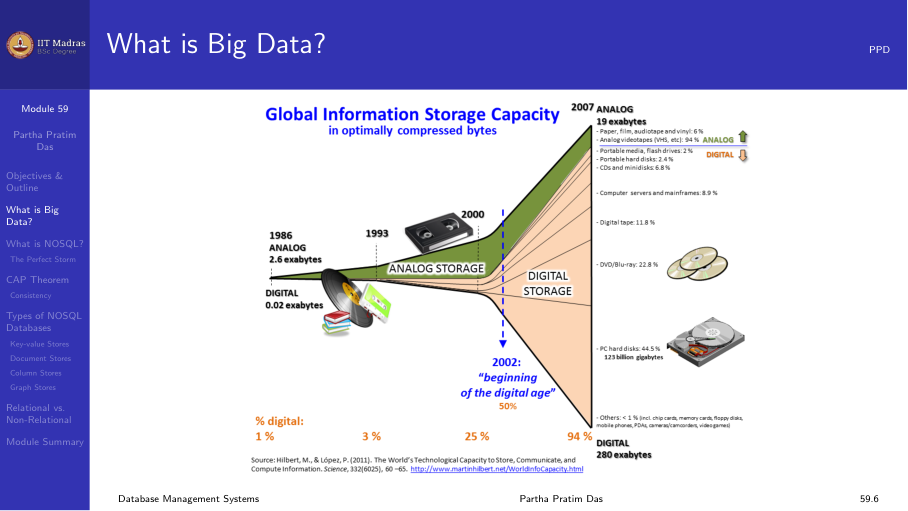
Sources of Big Data
- Social media feeds (Facebook, Twitter, Instagram).
- Sensor data from IoT devices.
- Web server logs.
- Scientific data (genomics, astronomy).
- Financial transactions.
Beyond the relational model
Relational databases were designed for structured data with well-defined schemas. Big Data challenges exposed limitations:
- Schema rigidity. Adding new attributes requires ALTER TABLE.
- Scaling difficulty. ACID compliance makes horizontal scaling hard.
- Performance. Joins across large distributed datasets are expensive.
- Unstructured data. Relational databases don’t handle text, images, and nested data well.
NoSQL databases
NoSQL (Not only SQL) databases emerged to address these challenges. They relax some of the constraints of relational databases to achieve scalability and flexibility.
Types of NoSQL databases
1. Key-value stores
Simplest NoSQL model. Data is stored as key-value pairs, similar to a dictionary or hash map. The key uniquely identifies a record, and the value is arbitrary data (often JSON or binary).
Examples: Redis, DynamoDB, Riak.
Use cases: Session management, caching, user profiles.
2. Document stores
Data is stored as documents, typically in JSON or BSON format. Each document can have a different structure, providing schema flexibility. Documents are grouped into collections (analogous to tables).
Examples: MongoDB, CouchDB.
Use cases: Content management, catalogs, real-time analytics.
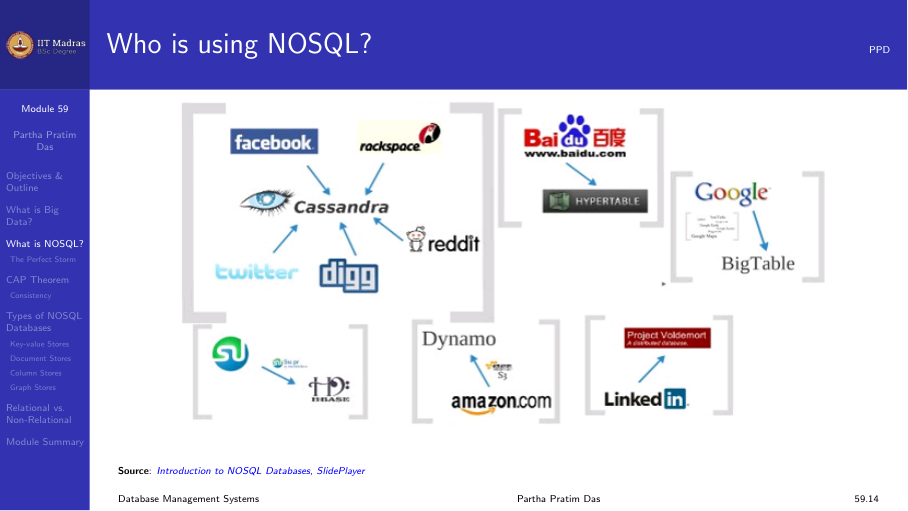
3. Column-family stores
Data is stored in column families rather than rows. Related columns are grouped together, and each row can have different columns. This is inspired by Google’s Bigtable.
Examples: Cassandra, HBase.
Use cases: Time-series data, logging, IoT data.
4. Graph databases
Data is modeled as nodes (entities) and edges (relationships). Optimized for traversing relationships between entities.
Examples: Neo4j, Amazon Neptune.
Use cases: Social networks, recommendation engines, fraud detection.
NoSQL and ACID
NoSQL databases typically relax one or more ACID properties:
- Eventually consistent. Instead of strong consistency, the system guarantees that if no updates are made, all replicas will eventually converge to the same state.
- BASE model (Basically Available, Soft state, Eventually consistent). A looser model compared to ACID.
The CAP theorem
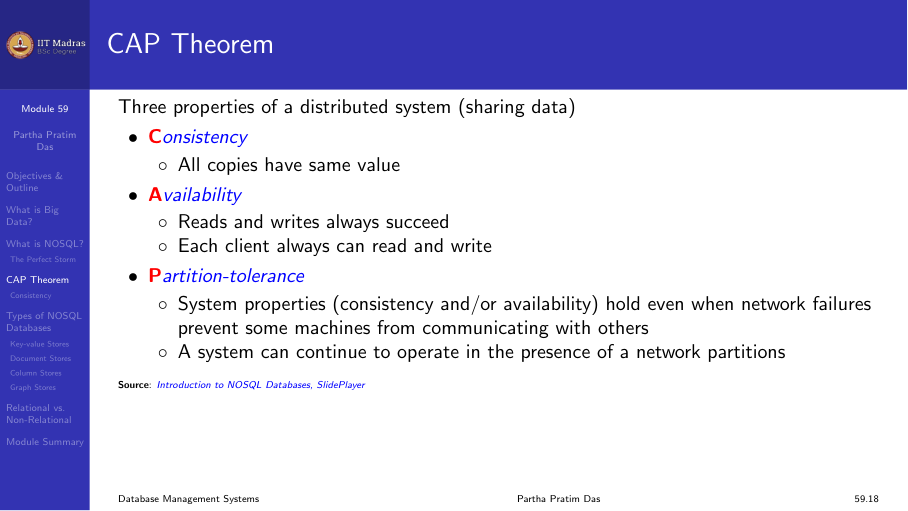
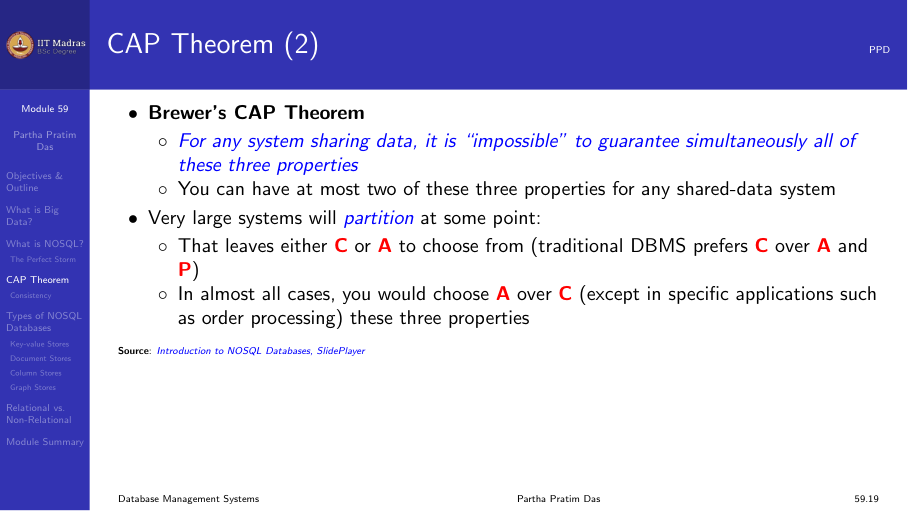
The CAP theorem, proved by Eric Brewer in 2000, states that a distributed system can guarantee only two of the following three properties:
- Consistency (C). All nodes see the same data at the same time. A read returns the most recent write.
- Availability (A). Every request receives a response (success or failure), even if some nodes are down.
- Partition tolerance (P). The system continues to function despite network partitions (communication breakdowns between nodes).
CAP theorem trade-offs
Since network partitions are inevitable in distributed systems, the choice is typically between CP and AP:
- CP (Consistency + Partition tolerance). Sacrifice availability (some nodes are unavailable during a partition). Example: HBase.
- AP (Availability + Partition tolerance). Sacrifice consistency (data may be stale during a partition, but the system stays up). Example: DynamoDB, Cassandra.
Real-world considerations
The CAP theorem is not binary — there are degrees of consistency and availability. Modern distributed databases offer tunable consistency: - Strong consistency (linearizability). - Eventual consistency. - Causal consistency.
Big Data processing frameworks
MapReduce
A programming model for processing large datasets in parallel across many machines. Developed by Google (2004). The model has two phases:
- Map. Processes input key-value pairs and produces intermediate key-value pairs.
- Reduce. Aggregates the intermediate pairs by key.
Hadoop is the open-source implementation of MapReduce.
Apache Spark
A successor to MapReduce that keeps data in memory for faster processing. Supports batch processing, streaming, machine learning, and graph processing.
CAP theorem and RDBMS
Traditional RDBMS systems prioritize consistency and availability (CA). In a distributed setting, this means they cannot tolerate network partitions gracefully. This is why scaling RDBMS across multiple data centers is difficult.
Summary
- Big Data is characterized by volume, velocity, and variety.
- NoSQL databases (key-value, document, column-family, graph) address limitations of relational databases for Big Data.
- The CAP theorem limits distributed systems: you can choose only two of Consistency, Availability, and Partition tolerance.
- MapReduce and Spark enable distributed processing of large datasets.