5.3 FD Theory, BCNF and 3NF
Functional Dependency Theory
Armstrong’s Axioms
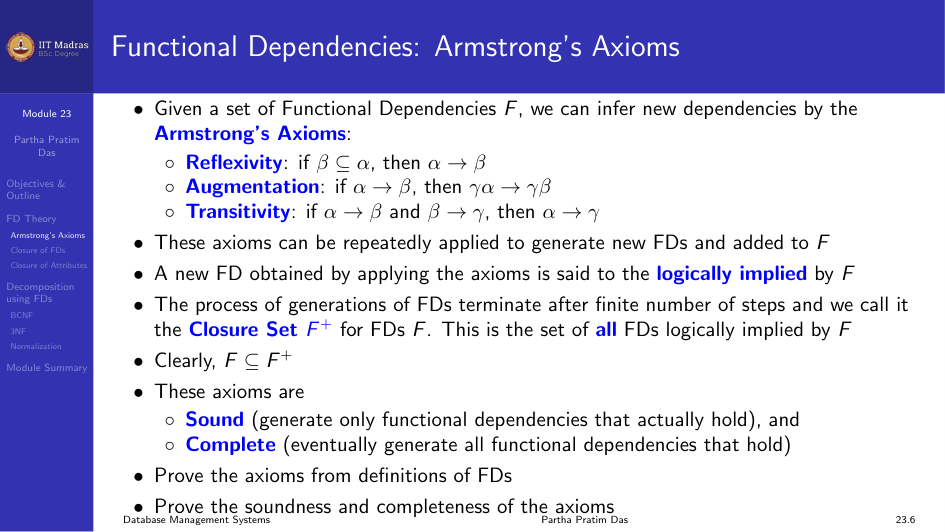
Given a set of functional dependencies F, we can infer new dependencies using Armstrong’s Axioms. These axioms are sound (they generate only FDs that actually hold) and complete (they eventually generate all FDs that hold).
- Reflexivity. If \beta \subseteq \alpha, then \alpha \rightarrow \beta.
- Augmentation. If \alpha \rightarrow \beta, then \gamma\alpha \rightarrow \gamma\beta.
- Transitivity. If \alpha \rightarrow \beta and \beta \rightarrow \gamma, then \alpha \rightarrow \gamma.
A new FD obtained by applying the axioms is said to be logically implied by F. The process of generation terminates after a finite number of steps, and we call the result the closure set F^+ for FDs F. This is the set of all FDs logically implied by F.
Derived Rules
- Union. If \alpha \rightarrow \beta holds and \alpha \rightarrow \gamma holds, then \alpha \rightarrow \beta\gamma holds.
- Decomposition. If \alpha \rightarrow \beta\gamma holds, then \alpha \rightarrow \beta holds and \alpha \rightarrow \gamma holds.
- Pseudotransitivity. If \alpha \rightarrow \beta holds and \gamma\beta \rightarrow \delta holds, then \alpha\gamma \rightarrow \delta holds.
These derived rules can be proven from the basic Armstrong axioms.
Example: Computing F^+
Let R = (A, B, C, G, H, I) and F = \{A \rightarrow B, A \rightarrow C, CG \rightarrow H, CG \rightarrow I, B \rightarrow H\}.
Some members of F^+: - A \rightarrow H by transitivity from A \rightarrow B and B \rightarrow H. - AG \rightarrow I by augmenting A \rightarrow C with G to get AG \rightarrow CG, then transitivity with CG \rightarrow I. - CG \rightarrow HI by augmenting CG \rightarrow I with CG to get CG \rightarrow CGI, augmenting CG \rightarrow H with I to get CGI \rightarrow HI, then transitivity.
Algorithm to Compute F^+
F+ := F
repeat
  for each FD f in F+:
    apply reflexivity and augmentation rules on f
    add resulting FDs to F+
  for each pair of FDs f1, f2 in F+:
    if f1 and f2 can be combined using transitivity
      add resulting FD to F+
until F+ does not change
Closure of Attribute Sets
Given a set of attributes \alpha, the closure of \alpha under F, denoted \alpha^+, is the set of attributes that are functionally determined by \alpha under F.
Algorithm to Compute \alpha^+
result := alpha
while (changes to result) do
  for each beta -> gamma in F do
    if beta ⊆ result then
      result := result ∪ gamma
Example
R = (A, B, C, G, H, I) and F = \{A \rightarrow B, A \rightarrow C, CG \rightarrow H, CG \rightarrow I, B \rightarrow H\}.
Compute (AG)^+:
- result = AG
- result = ABCG (using A \rightarrow C and A \rightarrow B)
- result = ABCGH (using CG \rightarrow H as CG \subseteq ABCG)
- result = ABCGHI (using CG \rightarrow I)
So (AG)^+ = ABCGHI.
Is AG a candidate key? - Is AG a superkey? Does (AG)^+ \supseteq R? Yes. - Is any subset of AG a superkey? Does A^+ \supseteq R? Does G^+ \supseteq R?
Uses of Attribute Closure
- Testing for superkey. To test if \alpha is a superkey, compute \alpha^+ and check if it contains all attributes of R.
- Testing functional dependencies. To check if \alpha \rightarrow \beta holds, check if \beta \subseteq \alpha^+.
- Computing closure of F. For each \gamma \subseteq R, find \gamma^+, and for each S \subseteq \gamma^+, output \gamma \rightarrow S.
Decomposition Using Functional Dependencies
BCNF: Boyce-Codd Normal Form
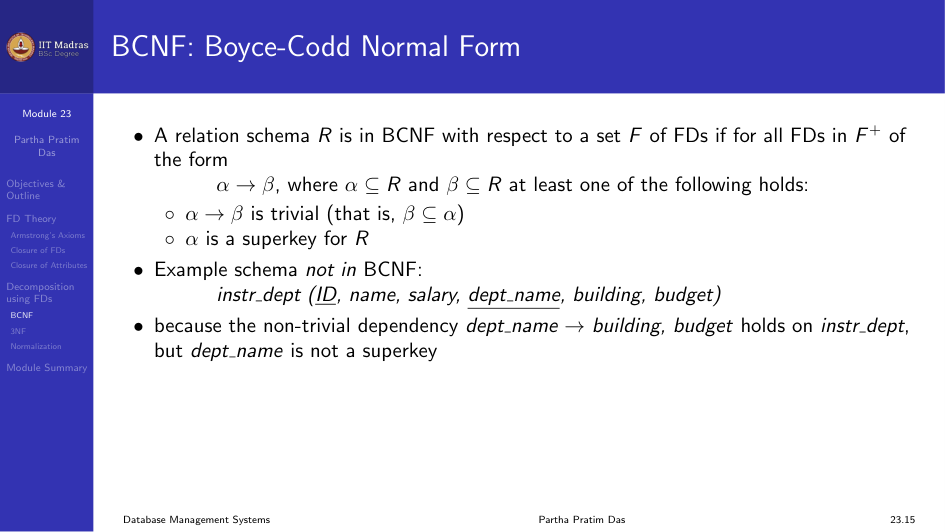
A relation schema R is in BCNF with respect to a set F of FDs if for all FDs in F^+ of the form \alpha \rightarrow \beta, at least one of the following holds: - \alpha \rightarrow \beta is trivial (\beta \subseteq \alpha) - \alpha is a superkey for R
Example Schema Not in BCNF
instr_dept(ID, name, salary, dept_name, building, budget) is not in BCNF because the non-trivial dependency dept_name -> building, budget holds, but dept_name is not a superkey.
BCNF Decomposition
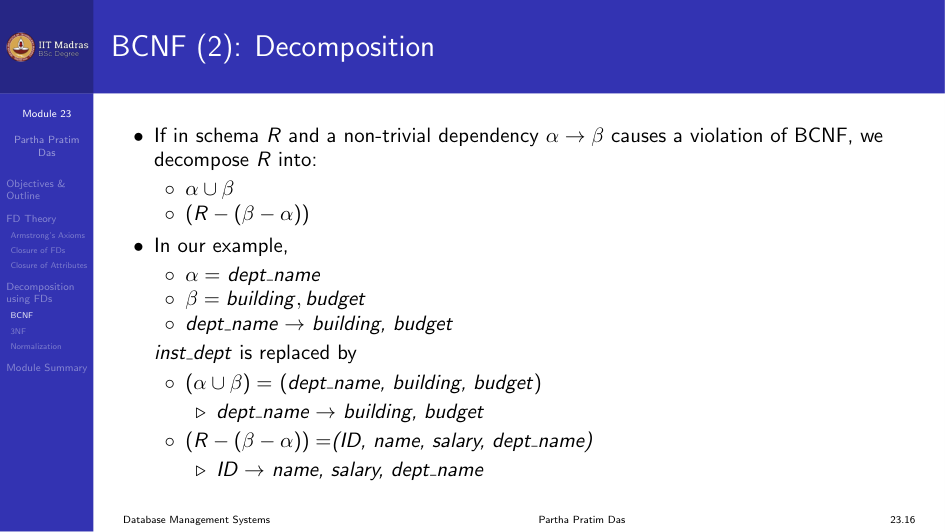
If in schema R a non-trivial dependency \alpha \rightarrow \beta causes a violation of BCNF, we decompose R into: - \alpha \cup \beta - R - (\beta - \alpha)
In our example: - \alpha = \text{dept\_name} - \beta = \text{building, budget} - R_1 = (\text{dept\_name, building, budget}) - R_2 = (\text{ID, name, salary, dept\_name})
Lossless Join in BCNF
If we decompose R into R_1 and R_2: - R_1 \cup R_2 = R (Union of attributes must be the same) - R_1 \cap R_2 \neq \emptyset (Intersection must not be null) - R_1 \cap R_2 \rightarrow R_1 or R_1 \cap R_2 \rightarrow R_2 (Common attribute must be a key for at least one relation)
BCNF ensures a lossless join.
Dependency Preservation in BCNF
It is not always possible to achieve both BCNF and dependency preservation.
Consider R = CSZ, F = \{CS \rightarrow Z, Z \rightarrow C\}. - Key = CS - CS \rightarrow Z satisfies BCNF, but Z \rightarrow C violates. - Decompose as R_1 = ZC, R_2 = SZ. This is lossless join. - However, we cannot check CS \rightarrow Z without doing a join. So it is not dependency preserving.
We consider a weaker normal form, 3NF, to handle this.
Third Normal Form (3NF)
A relation schema R is in 3NF if for all \alpha \rightarrow \beta \in F^+, at least one of the following holds: - \alpha \rightarrow \beta is trivial (\beta \subseteq \alpha) - \alpha is a superkey for R - Each attribute A in \beta - \alpha is contained in a candidate key for R (a prime attribute)
The third condition is a minimal relaxation of BCNF to ensure dependency preservation.
If a relation is in BCNF, it is also in 3NF.
Goals of Normalization
Let R be a relation schema with a set F of functional dependencies. The goals are: 1. Decide whether R is in good form. 2. If not, decompose it into a set of relation schemas \{R_1, R_2, \dots, R_n\} such that: - Each relation schema is in good form. - The decomposition is lossless join. - Preferably, the decomposition is dependency preserving.
Problems with Decomposition
There are three potential problems: - May be impossible to reconstruct the original relation (lossiness). - Dependency checking may require joins. - Some queries become more expensive.
You must consider these issues against the benefit of reduced redundancy.
How Good is BCNF?
There are database schemas in BCNF that still have problems. Consider:
inst_info(ID, child_name, phone)
An instructor may have more than one phone and can have multiple children. There are no non-trivial functional dependencies, so the relation is in BCNF. But insertion anomalies still exist. If we add a phone 981-992-3443 to instructor 99999, we need to add two tuples:
(99999, David, 981-992-3443)
(99999, William, 981-992-3443)
It is better to decompose inst_info into inst_child and inst_phone. This suggests the need for higher normal forms such as 4NF.
Module Summary
We introduced the theory of functional dependencies including Armstrong’s Axioms, closure of attribute sets, and decomposition using FDs. We discussed BCNF and 3NF, and the goals and problems of normalization.