5.5 Lossless Join and Dependency Preservation
Lossless Join Decomposition
When we decompose a relation into smaller relations, we need to be able to reconstruct the original relation by performing a natural join. If the join produces extra tuples that were not present in the original data, the decomposition is called lossy. If we get back exactly the original relation, it is called lossless.
Conditions for Lossless Join
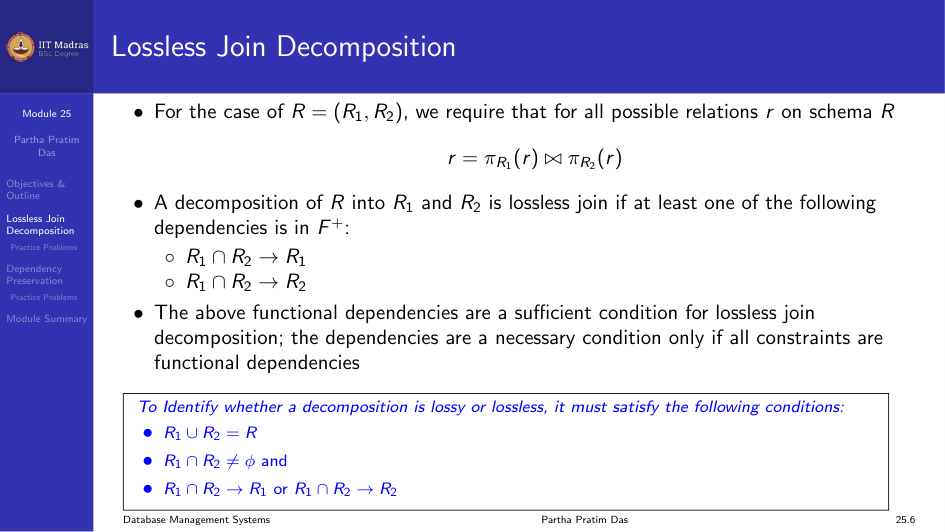
For the case of R = (R_1, R_2), a decomposition of R into R_1 and R_2 is lossless join if at least one of the following dependencies is in F^+:
- R_1 \cap R_2 \rightarrow R_1
- R_1 \cap R_2 \rightarrow R_2
In simpler terms, the three conditions are: 1. R_1 \cup R_2 = R (the union of attributes reconstructs the original set). 2. R_1 \cap R_2 \neq \emptyset (there is at least one common attribute). 3. R_1 \cap R_2 \rightarrow R_1 or R_1 \cap R_2 \rightarrow R_2 (the common attribute is a key for at least one of the relations).
Example: Lossy Decomposition
Consider the Supplier Parts schema:
Supplier_Parts(S#, Sname, City, P#, Qty)
Functional dependencies: - S# \rightarrow Sname - S# \rightarrow City - (S#, P#) \rightarrow Qty
Decompose as: Supplier(S#, Sname, City, Qty) and Parts(P#, Qty).
Take the natural join: Supplier $\bowtie$ Parts. We get extra tuples. The join is lossy. The common attribute Qty is not a superkey in either Supplier or Parts. The decomposition does not preserve (S#, P#) \rightarrow Qty.
Example: Lossless Decomposition
Same schema, but decompose as: Supplier(S#, Sname, City) and Parts(S#, P#, Qty).
Take the natural join: Supplier $\bowtie$ Parts. We get back the original relation. The join is lossless. The common attribute S# is a superkey in Supplier. All dependencies are preserved.
Another Example
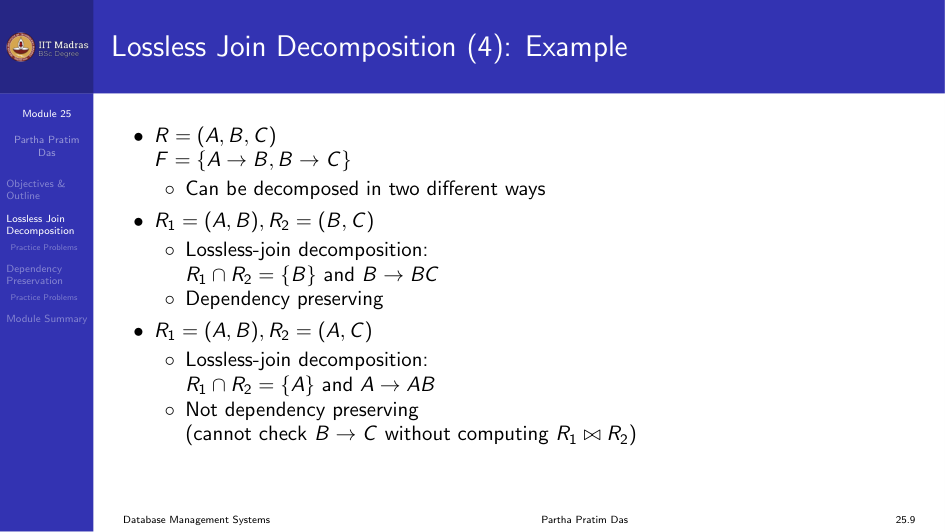
R = (A, B, C), F = \{A \rightarrow B, B \rightarrow C\}.
Decomposition 1: R_1 = (A, B), R_2 = (B, C). - Lossless join: R_1 \cap R_2 = \{B\} and B \rightarrow BC. - Dependency preserving.
Decomposition 2: R_1 = (A, B), R_2 = (A, C). - Lossless join: R_1 \cap R_2 = \{A\} and A \rightarrow AB. - Not dependency preserving because we cannot check B \rightarrow C without computing R_1 \bowtie R_2.
Practice Problems: Lossless Join
Check if the decomposition of R into D is lossless:
R(ABC): F = \{A \rightarrow B, A \rightarrow C\}. D = \{R_1(AB), R_2(BC)\}.
R(ABCDEF): F = \{A \rightarrow B, B \rightarrow C, C \rightarrow D, E \rightarrow F\}. D = \{R_1(AB), R_2(BCD), R_3(DEF)\}.
Dependency Preservation
When a relation is decomposed, it is important to ensure that functional dependencies that held in the original relation are still maintained.
Definition
Let F_i be the set of dependencies in F^+ that include only attributes in R_i. A decomposition is dependency preserving if:
(F_1 \cup F_2 \cup \dots \cup F_n)^+ = F^+
If it is not, checking updates for violation of functional dependencies may require computing joins, which is expensive.
In terms of F and the decomposed relations: - If F_1 \cup F_2 \equiv F, the decomposition preserves dependencies. - If F_1 \cup F_2 \subset F, the decomposition does NOT preserve dependencies. - F_1 \cup F_2 \supset F is not possible.
Testing Dependency Preservation (Exponential Time)
compute F+;
for each schema Ri in D do
begin
  Fi = the restriction of F+ to Ri;
end
F' = empty;
for each restriction Fi do
begin
  F' = F' ∪ Fi;
end
compute F'+;
if (F'+ = F+) then return true;
else return false;
This procedure takes exponential time because it requires computing F^+ and (F_1 \cup F_2 \cup \dots \cup F_n)^+.
Testing Dependency Preservation (Polynomial Time)
To check if a dependency \alpha \rightarrow \beta is preserved in a decomposition of R into R_1, R_2, \dots, R_n, apply the following test:
result = alpha;
while (changes to result) do
  for each Ri in the decomposition
    t = (result ∩ Ri)+ ∩ Ri;
    result = result ∪ t;
If result contains all attributes in beta,
  then the functional dependency alpha -> beta is preserved.
We apply this test on all dependencies in F to check if a decomposition is dependency preserving. This procedure takes polynomial time.
Example: Dependency Preservation
R(A, B, C, D, E, F), F = \{A \rightarrow BCD, A \rightarrow EF, BC \rightarrow AD, BC \rightarrow E, BC \rightarrow F, B \rightarrow F, D \rightarrow E\}.
Decomposition: R_1(A, B, C, D), R_2(B, F), R_3(D, E).
Restrictions: - F_1: includes A \rightarrow BCD, BC \rightarrow AD, and all implied FDs on \{A, B, C, D\}. - F_2: includes B \rightarrow F. - F_3: includes D \rightarrow E.
Check A \rightarrow E: A \rightarrow D (from R_1), D \rightarrow E (from R_3). So A \rightarrow E by transitivity. Preserved.
Check A \rightarrow F: A \rightarrow B (from R_1), B \rightarrow F (from R_2). So A \rightarrow F by transitivity. Preserved.
Check BC \rightarrow E: BC \rightarrow D (from R_1), D \rightarrow E (from R_3). So BC \rightarrow E by transitivity. Preserved.
Check BC \rightarrow F: B \rightarrow F (from R_2), augmented with C gives BC \rightarrow F. Preserved.
All dependencies are preserved.
Another Example
R(A, B, C, D), F = \{A \rightarrow B, B \rightarrow C, C \rightarrow D, D \rightarrow A\}.
Decomposition: R_1(A, B), R_2(B, C), R_3(C, D).
Check D \rightarrow A: D \rightarrow C (from R_3), C \rightarrow B (from R_2), B \rightarrow A (from R_1). So D \rightarrow A by transitivity. Preserved.
Practice Problems: Dependency Preservation
Check whether the decomposition of R into D preserves dependencies:
R(ABCD): F = \{A \rightarrow B, B \rightarrow C, C \rightarrow D, D \rightarrow A\}. D = \{AB, BC, CD\}.
R(ABCDEF): F = \{AB \rightarrow CD, C \rightarrow D, D \rightarrow E, E \rightarrow F\}. D = \{AB, CDE, EF\}.
R(ABCDEG): F = \{AB \rightarrow C, AC \rightarrow B, BC \rightarrow A, AD \rightarrow E, B \rightarrow D, E \rightarrow G\}. D = \{ABC, ACDE, ADG\}.
R(ABCD): F = \{A \rightarrow B, B \rightarrow C, C \rightarrow D, D \rightarrow B\}. D = \{AB, BC, BD\}.
R(ABCDE): F = \{A \rightarrow BC, CD \rightarrow E, B \rightarrow D, E \rightarrow A\}. D = \{ABCE, BD\}.
Module Summary
We understood the characterization for and determination of lossless join decomposition. We also understood the characterization for and determination of dependency preservation. A good decomposition must be lossless and should preferably preserve dependencies.