12.3 RDBMS performance and scalability
What do DBMS applications need?
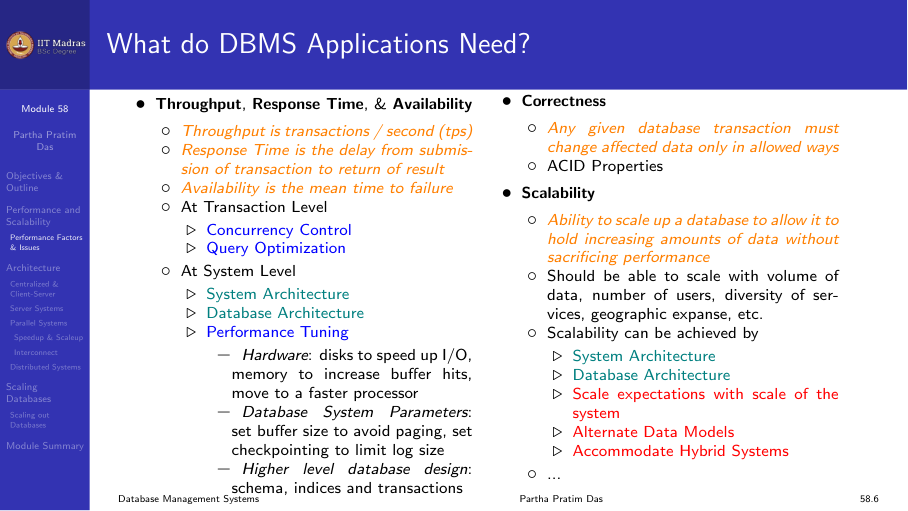
Modern database applications require:
- Throughput, response time, and availability. The system must process many transactions quickly and be available when needed.
- Correctness. ACID properties must be maintained.
- Scalability. The system should handle growing data volumes and user loads.
RDBMS architecture
Several architectural models exist for deploying relational databases:
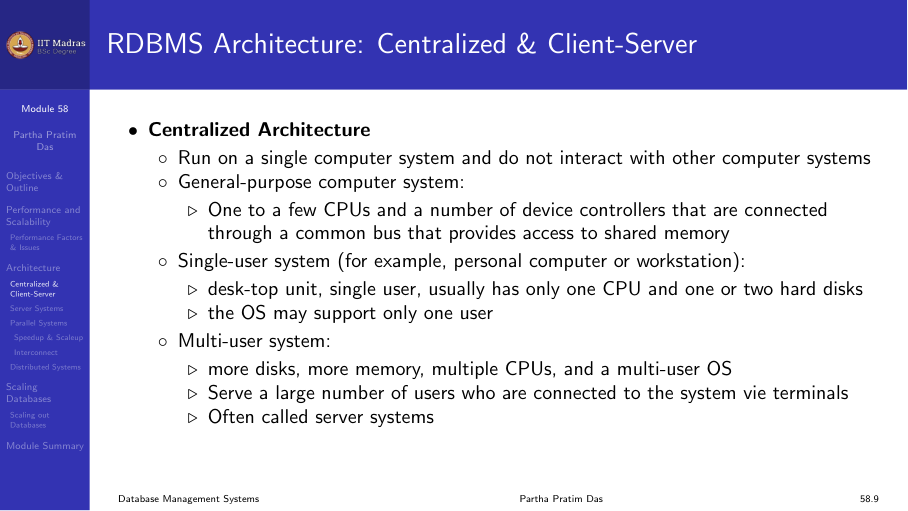
Centralized architecture
The database runs on a single computer system. One to a few CPUs and a number of device controllers are connected through a common bus. This is the simplest architecture, suitable for small to medium workloads.
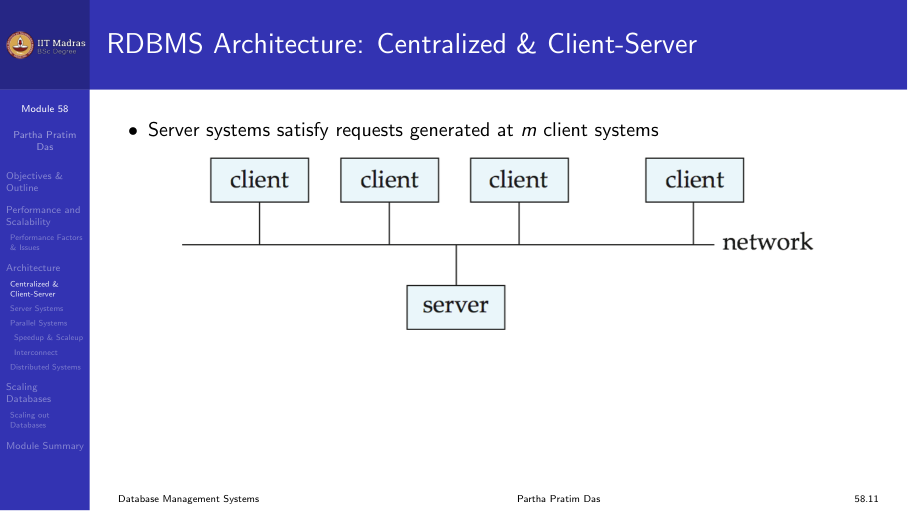
Client-server architecture
The database functionality is divided into:
- Back-end. Manages access structures, query evaluation and optimization, concurrency control, and recovery. Runs on the server.
- Front-end. Tools such as forms, report-writers, and graphical user interfaces. Run on client machines.
Clients send requests over the network, and the server processes them.
Transaction server
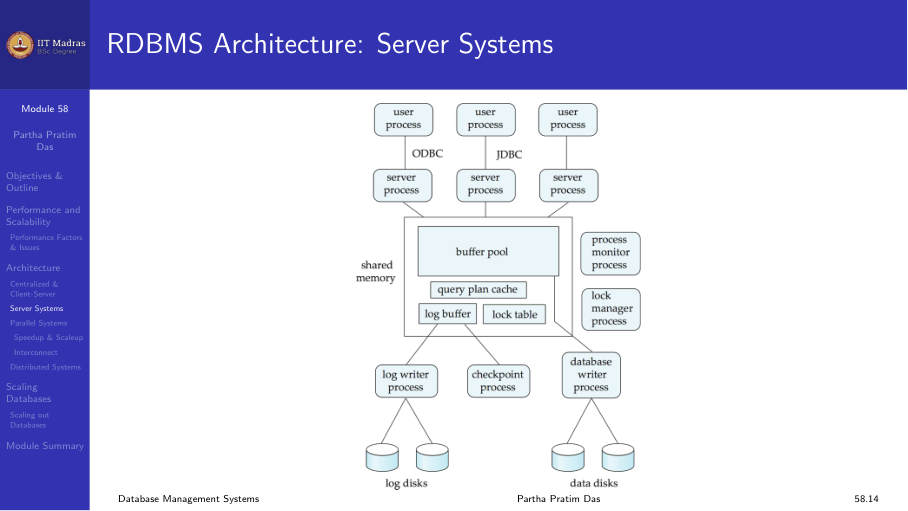
In a transaction server (also called query server) system:
- Clients send requests to the server.
- Transactions are executed at the server.
- Results are sent back to the client.
The server manages the buffer pool, concurrency control, and recovery.
Parallel systems
Parallel database systems consist of multiple processors and multiple disks connected by a fast interconnection network.
Speedup. A fixed-sized problem runs N times faster on an N-times larger system.
Scaleup. An N-times larger problem runs in the same time on an N-times larger system.
In practice, speedup and scaleup are sublinear due to communication overhead and contention.
Interconnect architectures
- Bus. Components send and receive data on a single communication bus. Does not scale well with increasing parallelism.
- Mesh. Components are arranged as nodes in a grid; each is connected to its neighbors.
Memory architectures
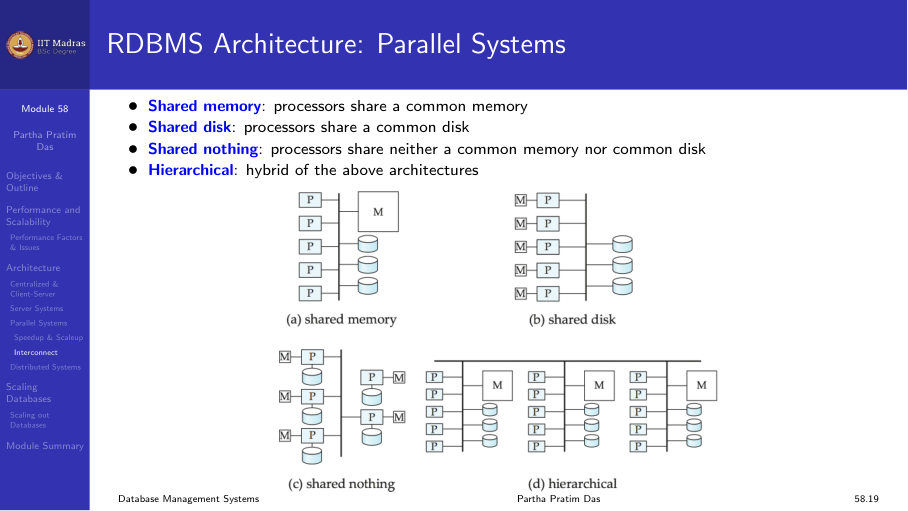
- Shared memory. All processors share a common memory.
- Shared disk. All processors share a common disk.
- Shared nothing. Processors share neither common memory nor common disk. Each has its own memory and disk.
- Hierarchical. Hybrid of the above.
Distributed systems
Data is spread over multiple machines (sites or nodes) connected by a network. Data is shared by users on multiple machines.
Homogeneous distributed databases
Same software and schema on all sites. Data may be partitioned among sites. The goal is to provide a view of a single database, hiding the details of distribution.
Heterogeneous distributed databases
Different software and schemas on different sites. More complex to manage.
Advantages of distributed databases
- Sharing data. Users at one site can access data at other sites.
- Autonomy. Each site retains control over its local data.
- Higher availability. Data can be replicated at multiple sites.
Scaling databases
Relational databases are the mainstay of business. However, web-based applications caused spikes in demand, and the explosion of social media sites (Facebook, Twitter) created large data needs. Cloud-based solutions (Amazon S3, etc.) emerged to address these challenges.
Horizontal versus vertical scaling
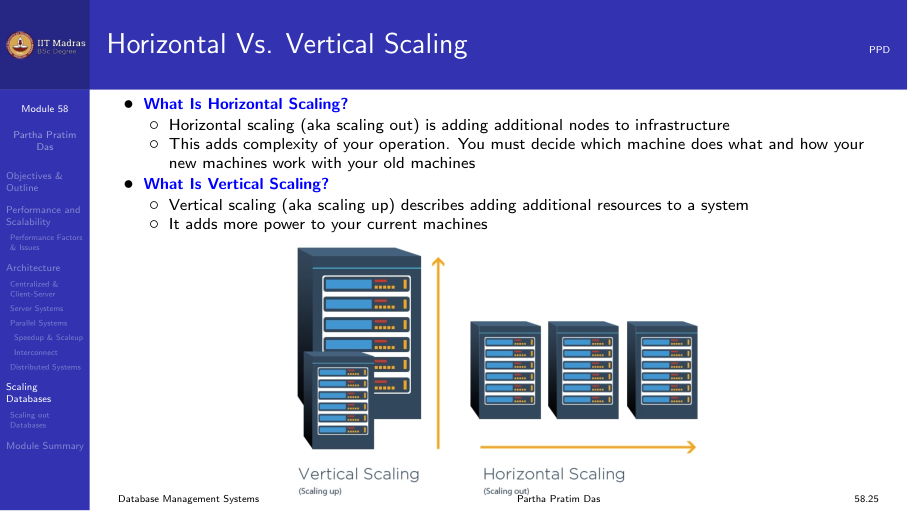
Vertical scaling (scaling up). Adding more power to a single machine (more CPUs, more memory, faster disks). Limited by the maximum capacity of a single machine.
Horizontal scaling (scaling out). Adding more machines to the infrastructure. This adds complexity — you must decide which machine does what and how new machines work with existing ones.
Summary
- DBMS applications need throughput, availability, correctness, and scalability.
- Architectures range from centralized to client-server to parallel to distributed.
- Parallel systems use shared memory, shared disk, or shared nothing designs.
- Distributed systems provide data sharing and autonomy across sites.
- Horizontal scaling (adding more machines) is the primary approach for handling large-scale workloads.