5.4 Algorithms for Functional Dependencies
This module covers algorithms for working with functional dependencies, including attribute set closure, extraneous attributes, equivalence of FD sets, and canonical covers.
Attribute Set Closure
We already saw the algorithm for computing \alpha^+ in the previous module. Here we review its uses.
Uses of Attribute Set Closure
- Testing for superkey. To test if \alpha is a superkey, compute \alpha^+ and check if it contains all attributes of R.
- Testing functional dependencies. To check if \alpha \rightarrow \beta holds, check if \beta \subseteq \alpha^+.
- Computing closure of F. For each \gamma \subseteq R, find \gamma^+, and for each S \subseteq \gamma^+, output \gamma \rightarrow S.
Extraneous Attributes
An attribute is said to be extraneous if we can remove it from a functional dependency without changing the closure of the dependency set.
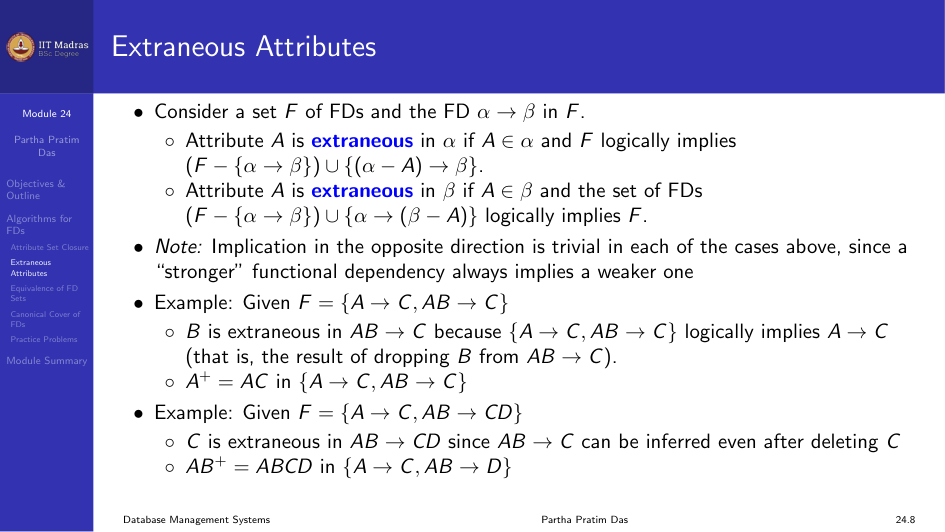
Consider a set F of FDs and the FD \alpha \rightarrow \beta in F:
- Attribute A is extraneous in \alpha if A \in \alpha and F logically implies (F - \{\alpha \rightarrow \beta\}) \cup \{(\alpha - A) \rightarrow \beta\}.
- Attribute A is extraneous in \beta if A \in \beta and the set of FDs (F - \{\alpha \rightarrow \beta\}) \cup \{\alpha \rightarrow (\beta - A)\} logically implies F.
Testing for Extraneous Attributes
To test if attribute A \in \alpha is extraneous in \alpha: 1. Compute (\{\alpha\} - \{A\})^+ using the dependencies in F. 2. Check that (\{\alpha\} - \{A\})^+ contains \beta. If it does, A is extraneous in \alpha.
To test if attribute A \in \beta is extraneous in \beta: 1. Compute \alpha^+ using only the dependencies in F' = (F - \{\alpha \rightarrow \beta\}) \cup \{\alpha \rightarrow (\beta - A)\}. 2. Check that \alpha^+ contains A. If it does, A is extraneous in \beta.
Examples
Given F = \{A \rightarrow C, AB \rightarrow C\}:
B is extraneous in AB \rightarrow C because \{A \rightarrow C, AB \rightarrow C\} logically implies A \rightarrow C (the result of dropping B from AB \rightarrow C).
Given F = \{A \rightarrow C, AB \rightarrow CD\}:
C is extraneous in AB \rightarrow CD since AB \rightarrow C can be inferred even after deleting C. AB^+ = ABCD in \{A \rightarrow C, AB \rightarrow D\}.
Equivalence of Sets of Functional Dependencies
Let F and G be two functional dependency sets. These two sets are equivalent if F^+ = G^+.
- F covers G: All functional dependencies of G are logically members of functional dependency set F, which means F^+ \supseteq G.
- G covers F: All functional dependencies of F are logically members of functional dependency set G, which means G^+ \supseteq F.
Canonical Cover
A canonical cover F_c for a set F of functional dependencies is a minimal set of FDs such that: 1. F^+ = F_c^+ (F logically implies all dependencies in F_c and F_c logically implies all dependencies in F). 2. No functional dependency in F_c contains an extraneous attribute. 3. Each left side of a functional dependency in F_c is unique. There are no two dependencies \alpha_1 \rightarrow \beta_1 and \alpha_2 \rightarrow \beta_2 in F_c such that \alpha_1 = \alpha_2.
A canonical cover is also called a minimal or irreducible set of FDs.
Algorithm to Compute Canonical Cover
repeat
  Use the union rule to replace any dependencies in F
    alpha1 -> beta1 and alpha1 -> beta2 with alpha1 -> beta1 beta2
  Find a functional dependency alpha -> beta with an
    extraneous attribute either in alpha or in beta
  If an extraneous attribute is found, delete it from alpha -> beta
until F does not change
Note: The union rule may become applicable after some extraneous attributes have been deleted, so it has to be reapplied.
Example
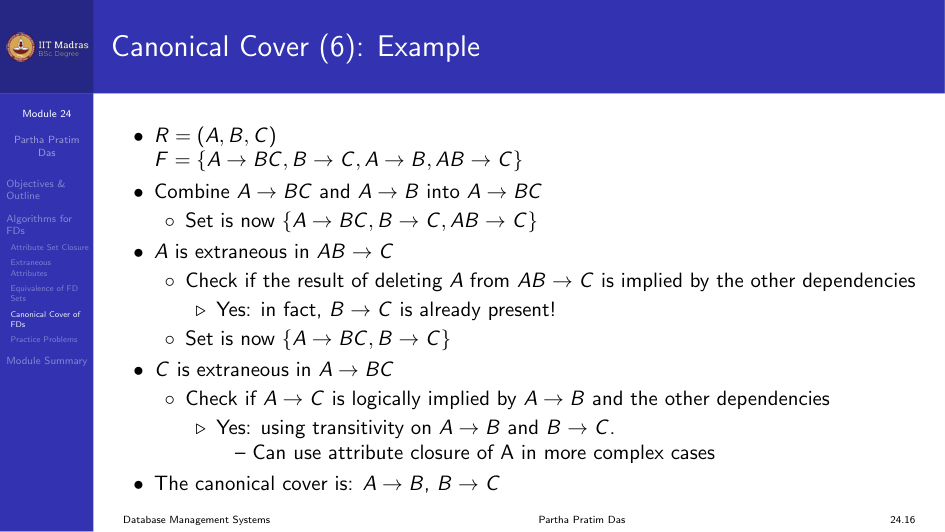
R = (A, B, C), F = \{A \rightarrow BC, B \rightarrow C, A \rightarrow B, AB \rightarrow C\}
- Combine A \rightarrow BC and A \rightarrow B into A \rightarrow BC. Set: \{A \rightarrow BC, B \rightarrow C, AB \rightarrow C\}.
- A is extraneous in AB \rightarrow C. Check if B \rightarrow C is implied by the other dependencies. Yes, B \rightarrow C is already present. Set: \{A \rightarrow BC, B \rightarrow C\}.
- C is extraneous in A \rightarrow BC. Check if A \rightarrow C is implied by A \rightarrow B and B \rightarrow C. Yes, using transitivity.
The canonical cover is: A \rightarrow B, B \rightarrow C.
Practice Problems
Check if a Given FD is Implied
For A \rightarrow BC, CD \rightarrow E, E \rightarrow C, D \rightarrow AEH, ABH \rightarrow BD, DH \rightarrow BC: - Check if BCD \rightarrow H holds. - Check if AED \rightarrow C holds.
Find Super Keys
Relational Schema R(ABCDE) with FDs AB \rightarrow C, DE \rightarrow B, CD \rightarrow E.
Find Candidate Keys
Relational Schema R(ABCDE) with FDs AB \rightarrow C, C \rightarrow D, B \rightarrow EA.
Find Prime and Non-Prime Attributes
For R(ABCDEF) with FDs \{AB \rightarrow C, C \rightarrow D, D \rightarrow E, F \rightarrow B, E \rightarrow F\}.
Check Equivalence of FD Sets
Consider the two sets: - F: A \rightarrow C, AC \rightarrow D, E \rightarrow AD, E \rightarrow H - G: A \rightarrow CD, E \rightarrow AH
Find Canonical Cover
For \{ABCD \rightarrow E, E \rightarrow D, AC \rightarrow D, A \rightarrow B\}.
Module Summary
We studied algorithms for the properties of functional dependencies, including attribute set closure, extraneous attributes, equivalence of FD sets, and canonical covers.