7.2 Web applications and database integration
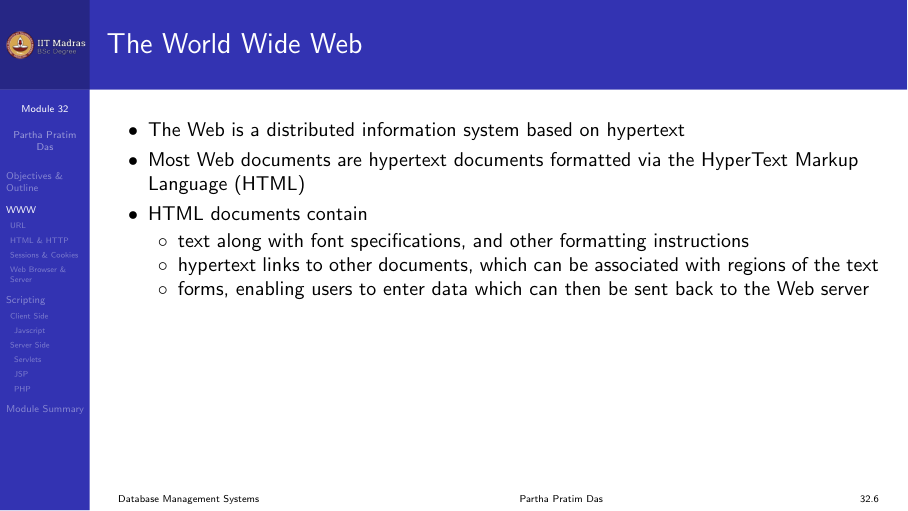
The World Wide Web
The Web is the platform for modern database applications. Understanding its fundamental technologies is essential for building database-backed web applications.
URL
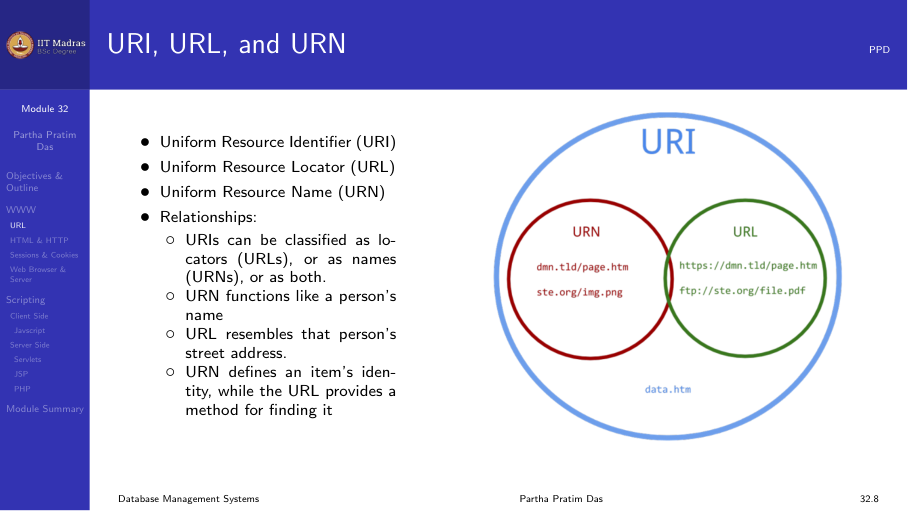
A Uniform Resource Locator (URL) identifies a resource on the web. It has three parts: the protocol (e.g., http, https), the host (e.g., www.example.com), and the path (e.g., /products/details).
HTML
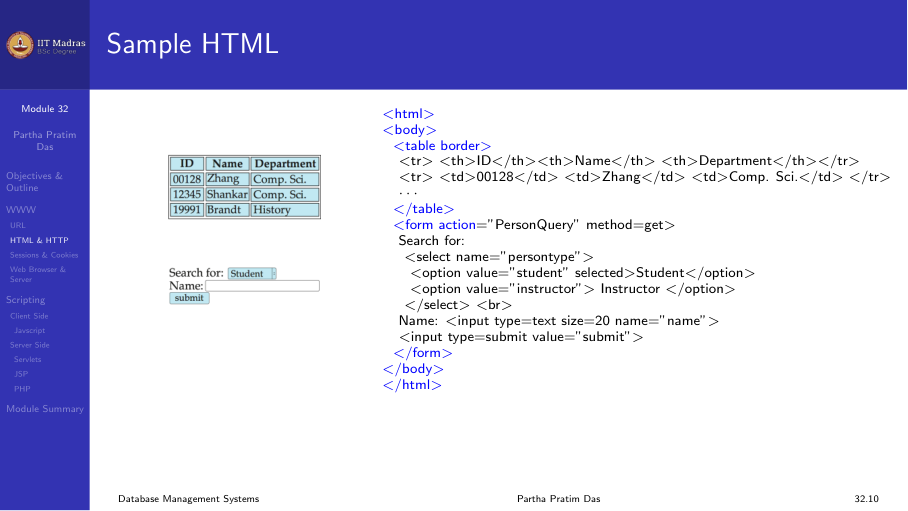
HTML (HyperText Markup Language) is the standard language for creating web pages. It uses tags to structure content — headings, paragraphs, links, images, tables, and forms.
Forms are particularly important for database applications. They collect user input (text fields, checkboxes, radio buttons, dropdowns) and send it to the server for processing.
HTTP
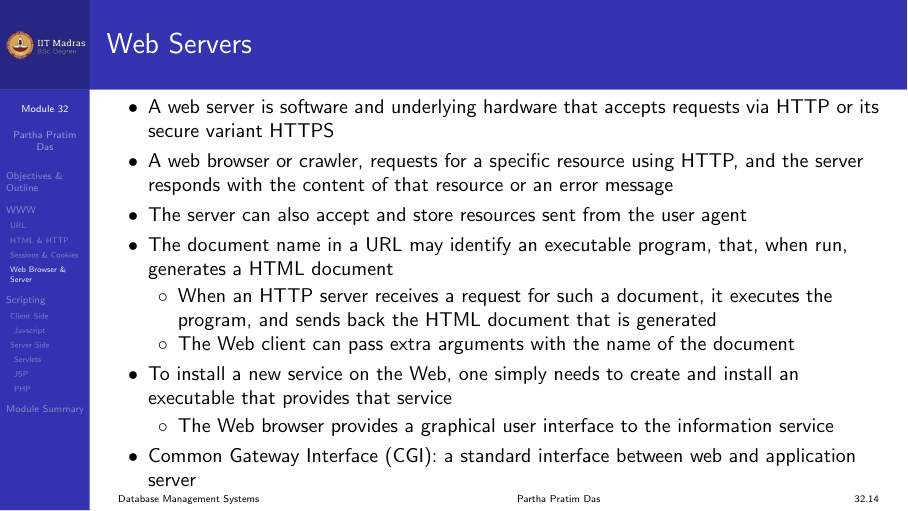
HTTP (HyperText Transfer Protocol) is the protocol used for communication between a web browser and a web server.
- GET. Requests data from the server. Parameters are appended to the URL. Used for simple retrievals like viewing a page or searching.
- POST. Submits data to the server. Parameters are in the request body. Used for form submissions, login, and data modifications.
HTTP is stateless — each request is independent. The server does not remember past requests by default.
Sessions and cookies
Because HTTP is stateless, we need mechanisms to maintain state across requests:
- Cookies. Small pieces of data stored in the browser. The server sends a cookie, and the browser sends it back with every subsequent request. Used for session IDs, preferences, and tracking.
- Sessions. Server-side storage of user state. A session is identified by a unique ID, typically stored in a cookie. The session object can hold data like login status, cart contents, and user preferences.
Web browser and web server
- Web browser. The client-side application (Chrome, Firefox, Safari) that renders HTML, executes JavaScript, and manages cookies and sessions.
- Web server. The server-side application (Apache, Nginx) that handles HTTP requests, serves static files, and passes dynamic requests to application code.
Client-side scripting
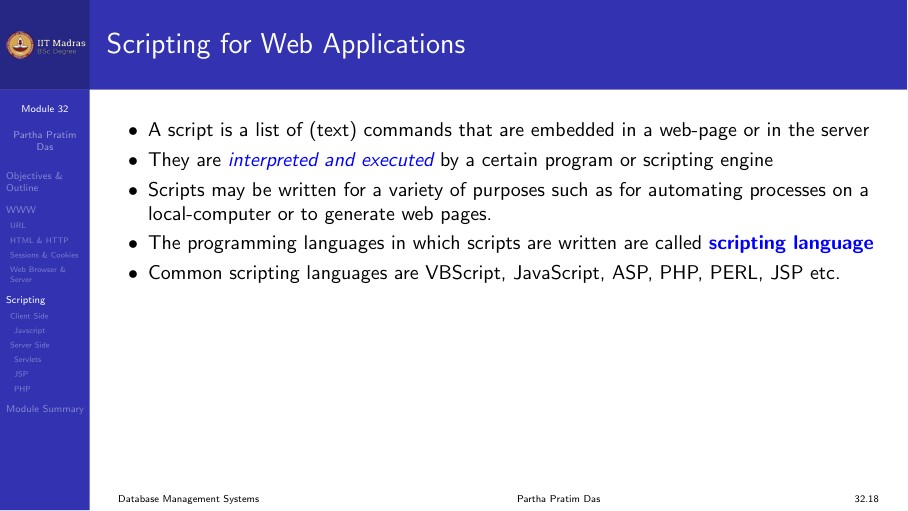
Client-side scripting runs in the browser, not on the server. The primary language for client-side scripting is JavaScript.
JavaScript enables: - Form validation before submission - Dynamic content updates without page reload (AJAX) - Interactive UI elements (dropdowns, modals, sliders) - Client-side data storage (localStorage)
This reduces server load and improves user experience by providing instant feedback.
Server-side scripting
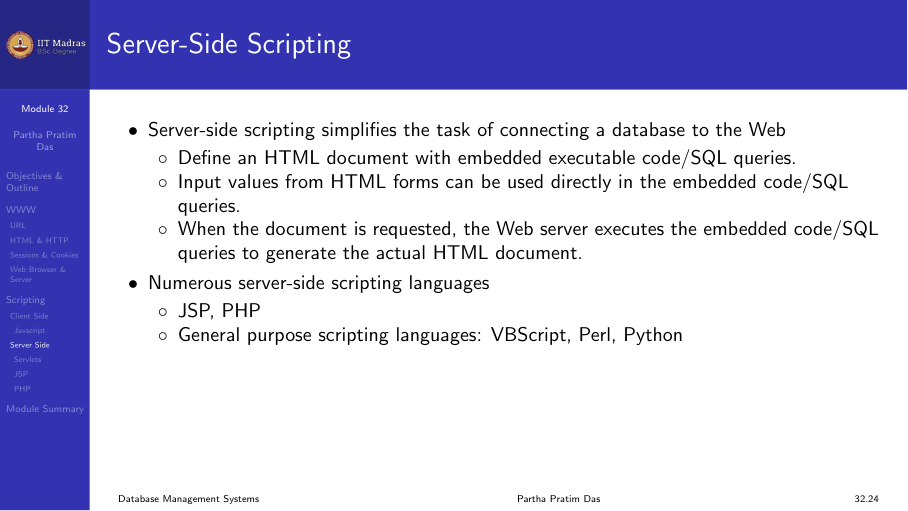
Server-side scripting runs on the web server. It has access to databases, file systems, and other server resources.
Common server-side technologies include: - Servlets. Java-based server-side components that handle HTTP requests and generate dynamic HTML. They have full access to Java libraries and JDBC for database connectivity. - JSP (Java Server Pages). A technology that allows embedding Java code in HTML pages. JSP pages are compiled into servlets and executed on the server. - PHP. A widely used scripting language designed for web development. PHP code is embedded in HTML and executed on the server. - ASP.NET. Microsoft’s server-side framework. - Node.js. JavaScript-based server-side runtime.
Servlets
A servlet is a Java class that extends the capabilities of a server. It receives HTTP requests and generates responses, typically in HTML.
The servlet lifecycle: 1. init() — called when the servlet is loaded. 2. service() — handles each request (doGet, doPost, etc.). 3. destroy() — called when the servlet is unloaded.
Servlets use JDBC to connect to databases, execute queries, and return results as HTML.
JSP (Java Server Pages)
JSP allows mixing HTML with Java code using special tags: - <% ... %> — scriptlet (Java code) - <%= ... %> — expression (output value) - <%@ ... %> — directive (page settings, imports)
JSP pages are compiled into servlets, so they have the same capabilities as servlets but are easier to write.
PHP
PHP is a server-side scripting language that is particularly suited for web development. PHP code is embedded in HTML and executed on the server.
<?php
  $conn = mysqli_connect("localhost", "user", "pass", "db");
  $result = mysqli_query($conn, "SELECT * FROM users");
  while ($row = mysqli_fetch_assoc($result)) {
    echo $row["name"] . "<br>";
  }
?>
PHP has built-in support for many databases including MySQL, PostgreSQL, and Oracle.
Comparison of server-side technologies
| Technology | Language | Platform | Database access |
|---|---|---|---|
| Servlets | Java | Cross-platform | JDBC |
| JSP | Java | Cross-platform | JDBC |
| PHP | PHP | Cross-platform | mysqli, PDO |
| ASP.NET | C#, VB.NET | Windows (.NET) | ADO.NET |
| Node.js | JavaScript | Cross-platform | Various drivers |
Module summary
Web applications rely on a stack of technologies: HTML for structure, HTTP for communication, cookies and sessions for state management, JavaScript for client-side interactivity, and server-side technologies (Servlets, JSP, PHP, etc.) for business logic and database access.