4.1 Relational Algebra
Relational Algebra and Relational Calculus are the foundational theoretical parts which tell how data is retrieved from a DBMS. SQL’s inner working is derived from these two core ideas.
When we type a query:
SELECT * FROM Student;the database converts it into a relational algebra expression.
What SQL can do, Relational Algebra and Relational Calculus can also do.
What is Relational Algebra?
Relational Algebra was created by Edgar F. Codd at IBM in 1970. It is a procedural language. In a procedural language, we mention clearly what the predicate should be, what the condition is, what should be selected or projected, and what result should be computed.
Relational Algebra has two main operations: Selection and Projection. There are six basic operators in total. The operators may be unary or binary. The result of any operation is always a new relation.
Selection Operation
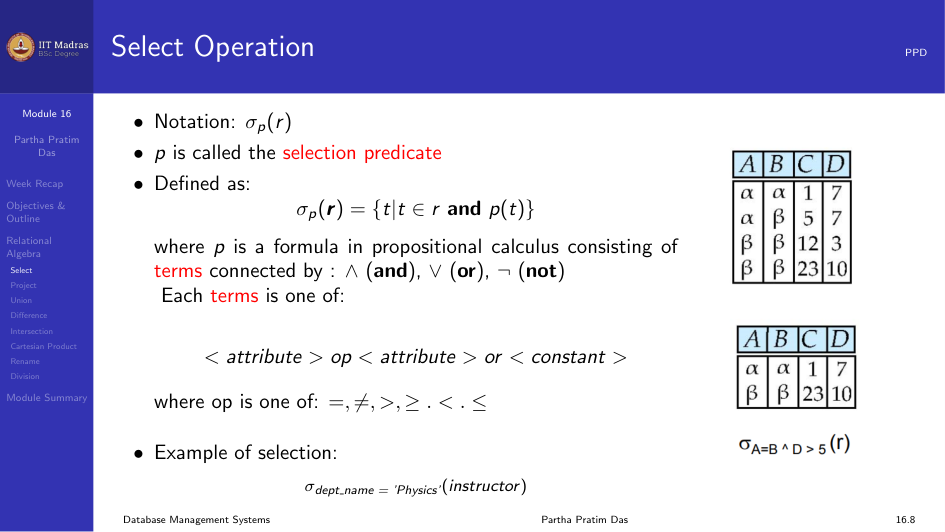
A SELECT query in SQL returns columns. The Selection Operation returns the rows of a relation.
Notation:
\sigma_p(r)
where p is called the selection predicate. It is defined as:
\sigma_p(r) = \{ t \mid t \in r \text{ and } p(t) \}
where p is a formula in propositional calculus consisting of terms connected by \land (and), \lor (or), \lnot (not). Each term is one of:
where op is one of: =, \neq, >, \ge, <, \le.
Example:
\sigma_{\text{dept\_name} = \text{'Physics'}} (\text{instructor})
This returns all instructors whose department name is Physics. The queries won’t be this simple. They will be combined with Projection and other operations.
Projection Operation
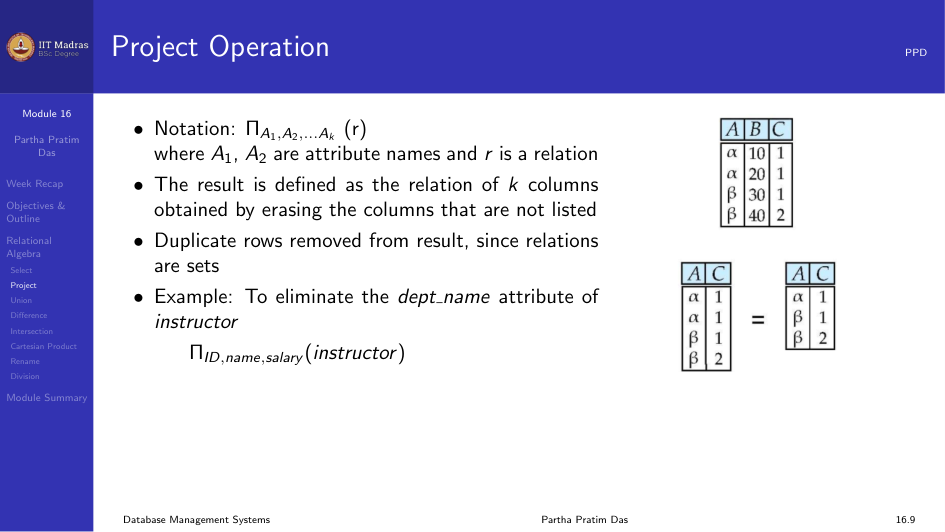
Projection operation is used to display columns. In Projection Operation, duplicate values are removed because relations are sets.
Notation:
\Pi_{A_1, A_2, \dots, A_k} (r)
where A_1, A_2 are attribute names and r is a relation.
Example: To eliminate the dept_name attribute of instructor:
\Pi_{\text{ID}, \text{name}, \text{salary}} (\text{instructor})
Union Operation
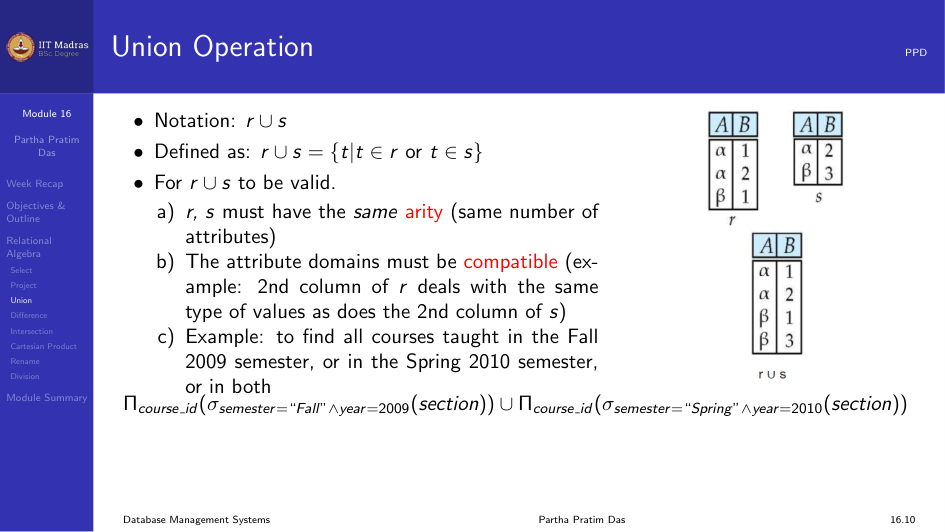
Union Operation is used to return all the unique tuples from both relations.
Notation:
r \cup s
Defined as:
r \cup s = \{ t \mid t \in r \text{ or } t \in s \}
Union Compatibility. For r \cup s to be valid, the following three rules must apply:
- Both relations must have the same datatype.
- Both relations must have the same arity (same number of attributes).
- The order of the attribute datatypes must be the same. For example, if the first relation has an attribute
Nameof typevarchar, then the second relation’s first attribute must also be of typevarchar.
Example: Find all courses taught in the Fall 2009 semester, or in the Spring 2010 semester, or in both.
\Pi_{\text{course\_id}}(\sigma_{\text{semester}=\text{"Fall"} \land \text{year}=2009}(\text{section})) \;\cup\; \Pi_{\text{course\_id}}(\sigma_{\text{semester}=\text{"Spring"} \land \text{year}=2010}(\text{section}))
Difference Operation
Notation:
r - s
Defined as:
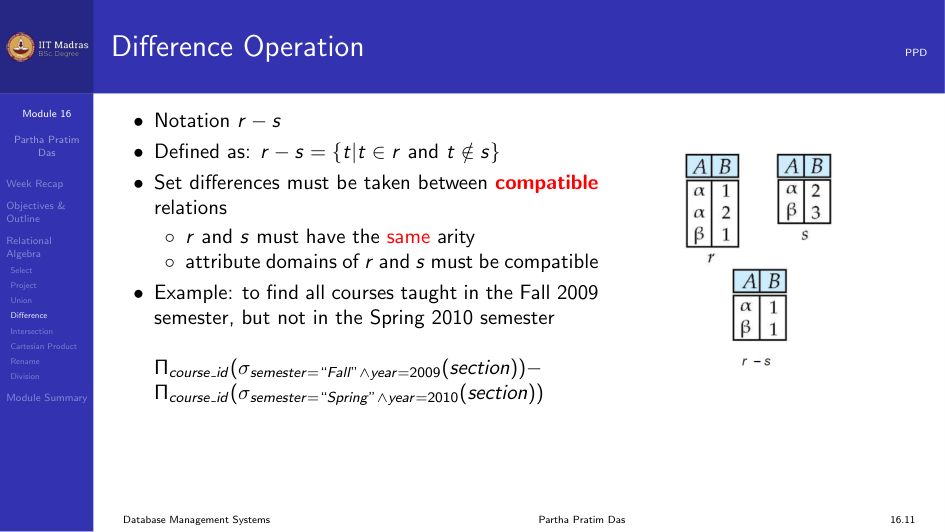
r - s = \{ t \mid t \in r \text{ and } t \notin s \}
The compatibility rules for union apply for difference operation also.
If we take two relations r and s, the difference operation will display the tuples of all elements in r and remove the common elements of s in r.
Example: Find all courses taught in the Fall 2009 semester but not in the Spring 2010 semester.
\Pi_{\text{course\_id}}(\sigma_{\text{semester}=\text{"Fall"} \land \text{year}=2009}(\text{section})) \;-\; \Pi_{\text{course\_id}}(\sigma_{\text{semester}=\text{"Spring"} \land \text{year}=2010}(\text{section}))
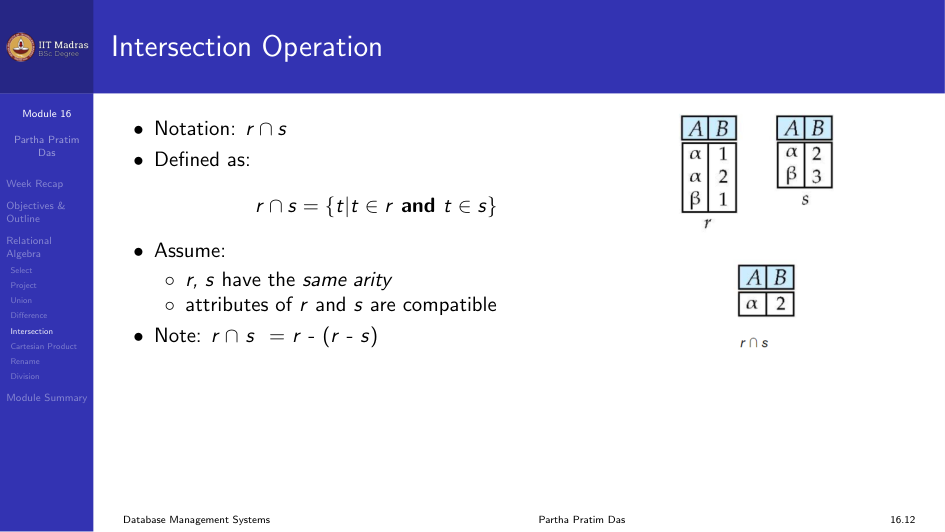
Intersection Operation
Notation:
r \cap s
Defined as:
r \cap s = \{ t \mid t \in r \text{ and } t \in s \}
The same compatibility rules apply. Intersection can be derived from set difference:
r \cap s = r - (r - s)
Intersection returns only the common tuples present in both relations.
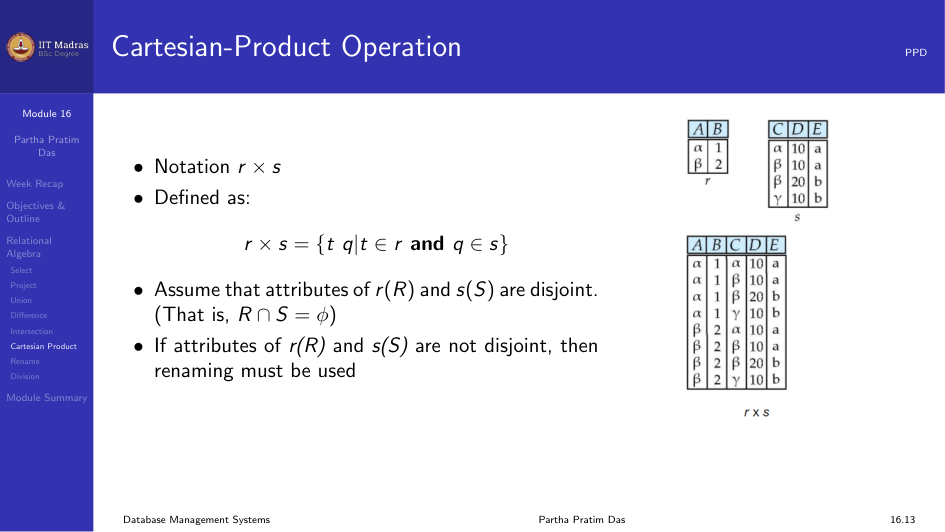
Cartesian Product
Notation:
r \times s
Defined as:
r \times s = \{ t \, q \mid t \in r \text{ and } q \in s \}
Cartesian Product is used to give all the possible combinations of both the relations. This assumes that the attributes of r(R) and s(S) are disjoint. If both relations have the same attributes when performing a Cartesian Product, then we denote the attributes with the relation prefix.
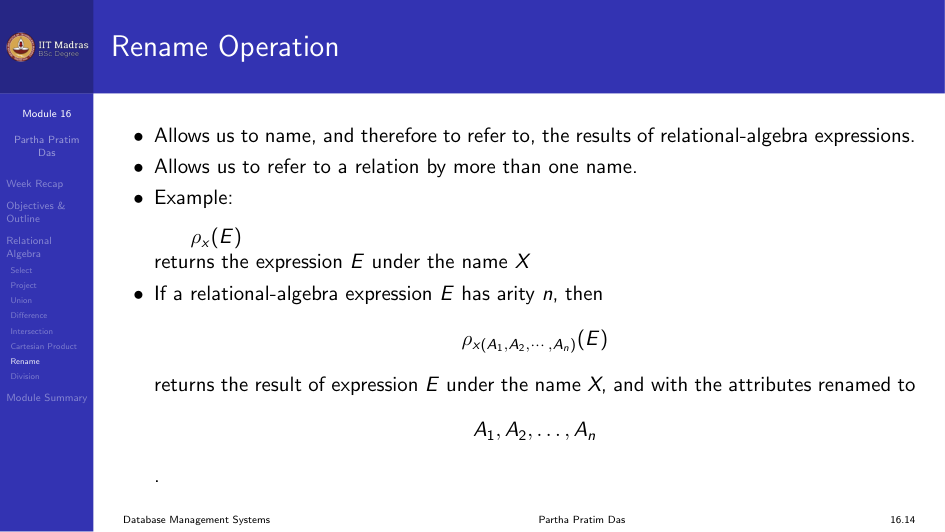
Rename Operation
The rename operation allows us to refer to a relation by more than one name. We can also rename the attributes of a relation.
Example:
\rho_X(E)
returns the expression E under the name X.
If a relational-algebra expression E has arity n, then:
\rho_{X(A_1, A_2, \dots, A_n)}(E)
returns the result of expression E under the name X, with the attributes renamed to A_1, A_2, \dots, A_n.
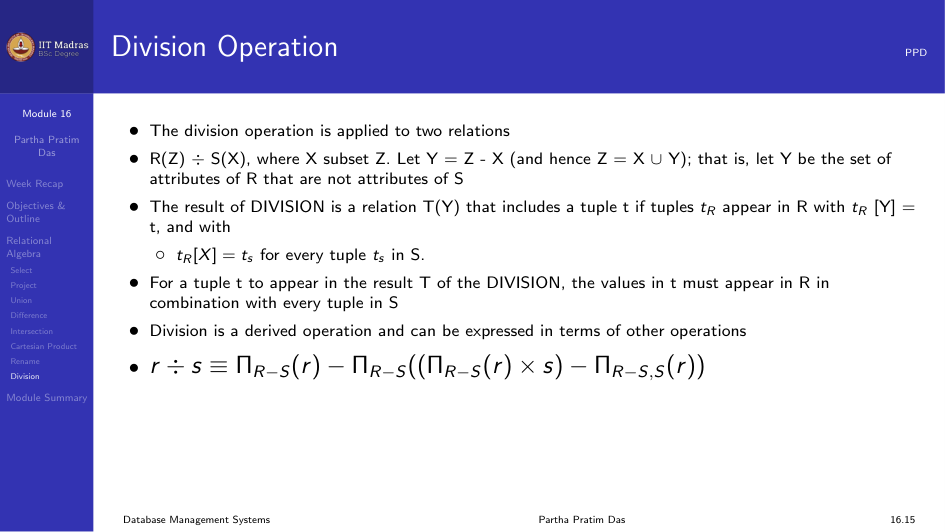
Division Operation
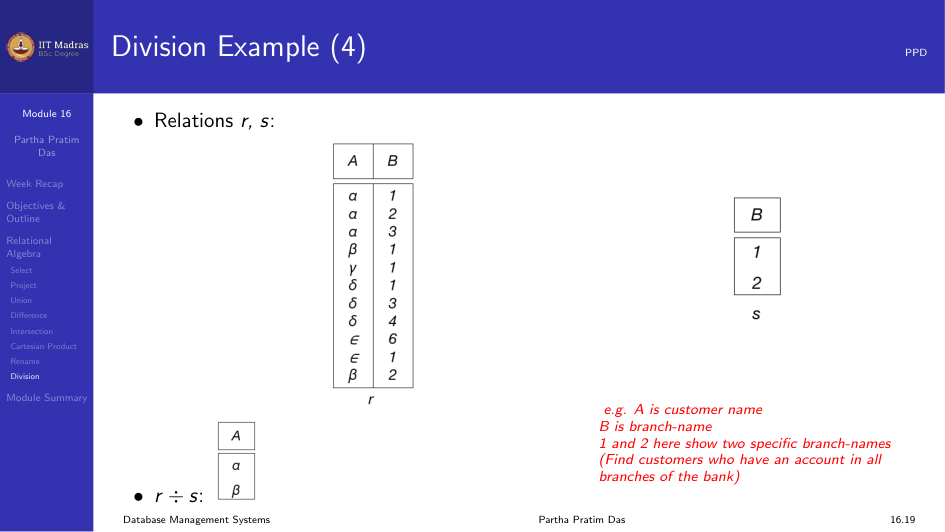
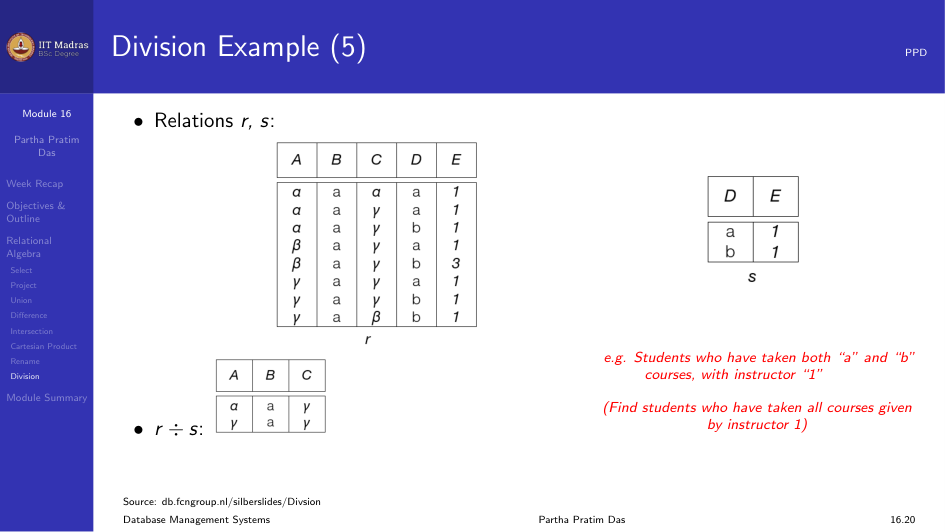
Division Operation is used to return the values of R that have both the values of S in R.
R(Z) \div S(X), where X \subseteq Z. Let Y = Z - X. The result of division is a relation T(Y) that includes a tuple t if tuples t_R appear in R with t_R[Y] = t, and with t_R[X] = t_s for every tuple t_s in S.
Division is a derived operation and can be expressed in terms of other operations:
r \div s \equiv \Pi_{R-S}(r) - \Pi_{R-S}((\Pi_{R-S}(r) \times s) - \Pi_{R-S,S}(r))
Division Examples
Find customers who have an account in all branches of the bank.
Find students who have taken all courses given by instructor 1.
Module Summary
In this module we discussed relational algebra. Relational Algebra is a procedural language where we specify how to compute a query using operators like select, project, union, difference, intersection, cartesian product, rename, and division.