4.4 Entity-Relationship Model/2
In this module we look at ER Diagram notation and how to translate ER Models into relational schemas.
ER Diagram Notation
Entity sets and relationship sets can be represented graphically using standard symbols.
- Rectangles represent entity sets.
- Attributes are listed inside the entity rectangle.
- An underline indicates the primary key attribute.
- Diamonds represent relationship sets.
Relationship Sets with Attributes
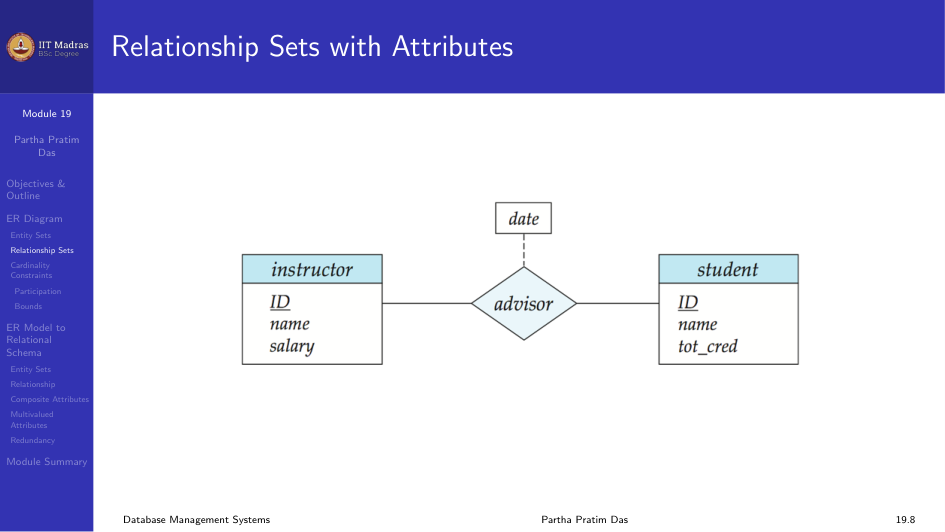
Relationship sets can also have descriptive attributes. For example, the advisor relationship may have a date attribute.
Roles
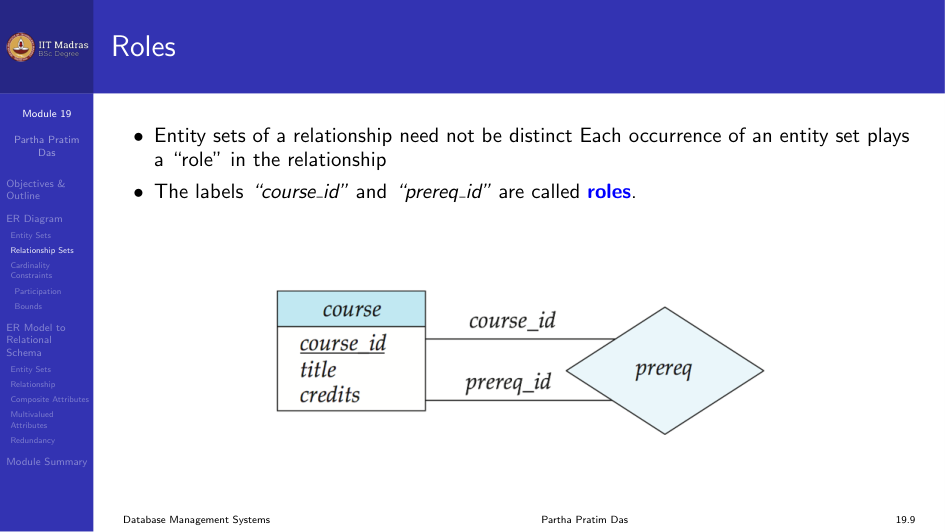
Entity sets in a relationship need not be distinct. Each occurrence of an entity set plays a role in the relationship. For example, in the prereq relationship, the labels course_id and prereq_id are called roles.
Cardinality Constraints in ER Diagrams
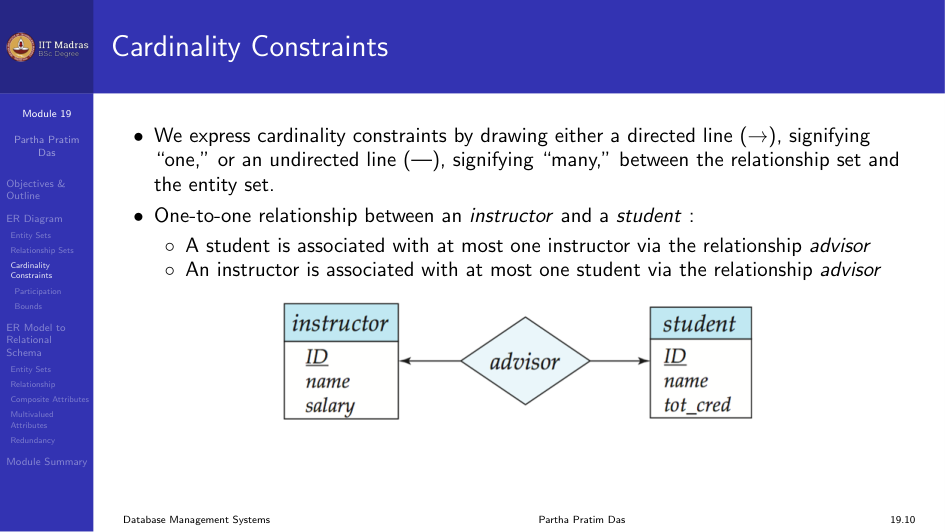
We express cardinality constraints by drawing either a directed line (\rightarrow), signifying “one”, or an undirected line (-), signifying “many”, between the relationship set and the entity set.
- One-to-one: arrow on both sides.
- One-to-many: arrow on the “one” side.
- Many-to-many: no arrows.
Expressing More Complex Constraints
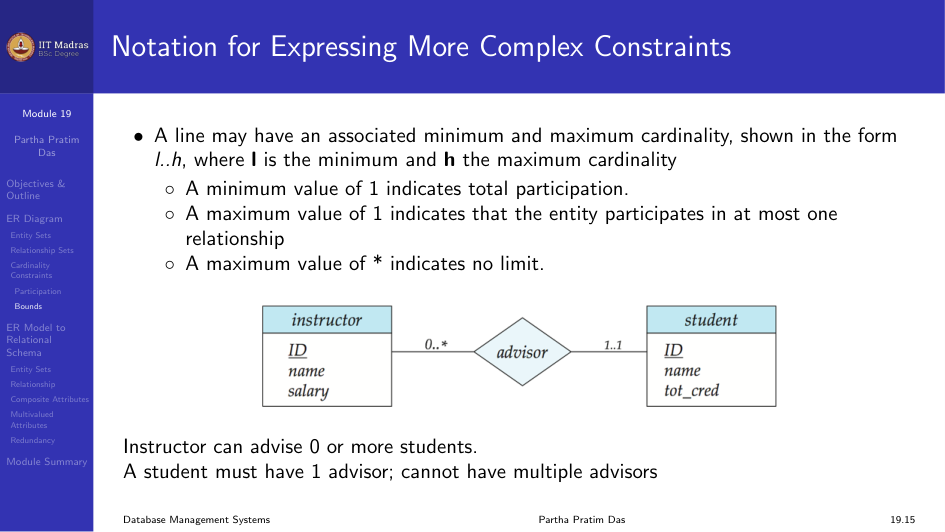
A line may have an associated minimum and maximum cardinality, shown in the form l..h, where l is the minimum and h is the maximum cardinality.
- A minimum value of 1 indicates total participation.
- A maximum value of 1 indicates that the entity participates in at most one relationship.
- A maximum value of * indicates no limit.
For example, an instructor can advise 0 or more students. A student must have 1 advisor and cannot have multiple advisors.
Weak Entity Sets in ER Diagrams
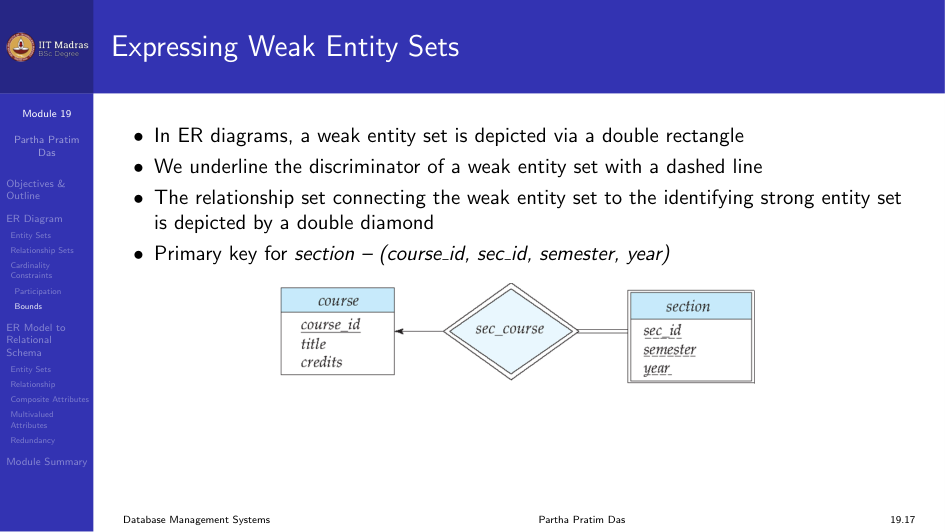
- A weak entity set is shown with a double rectangle.
- The discriminator is underlined with a dashed line.
- The identifying relationship is shown with a double diamond.
- Primary key for
sectionis (course_id, sec_id, semester, year).
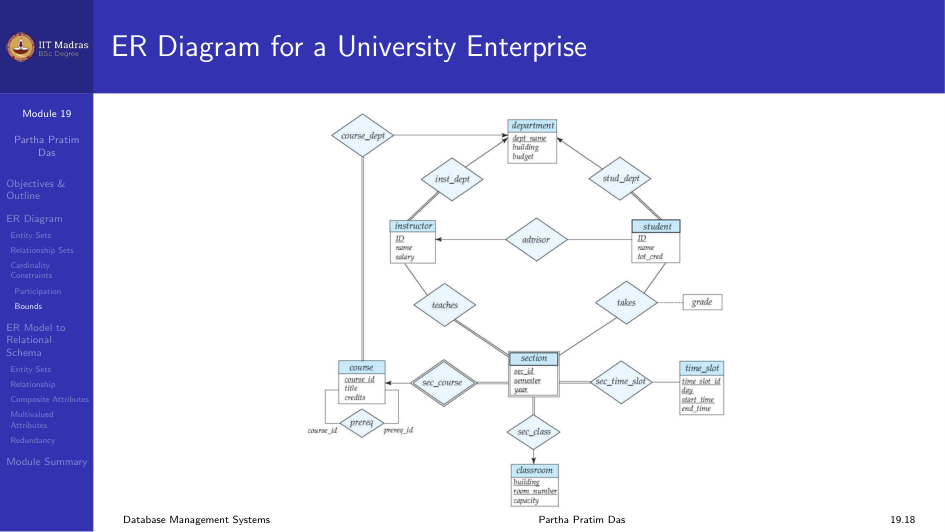
Complete ER Diagram for a University Enterprise
Reduction to Relational Schema
Entity sets and relationship sets can be expressed uniformly as relation schemas that represent the contents of the database. For each entity set and relationship set, there is a unique schema that is assigned the name of the corresponding entity set or relationship set.
Representing Strong Entity Sets
A strong entity set reduces to a schema with the same attributes.
\text{student}(\text{ID}, \text{name}, \text{tot\_cred})
Representing Weak Entity Sets
A weak entity set becomes a table that includes a column for the primary key of the identifying strong entity set.
\text{section}(\text{course\_id}, \text{sec\_id}, \text{sem}, \text{year})
Representing Relationship Sets
A many-to-many relationship set is represented as a schema with attributes for the primary keys of the two participating entity sets and any descriptive attributes.
Example: schema for relationship set advisor:
\text{advisor} = (\text{s\_id}, \text{i\_id})
Composite Attributes
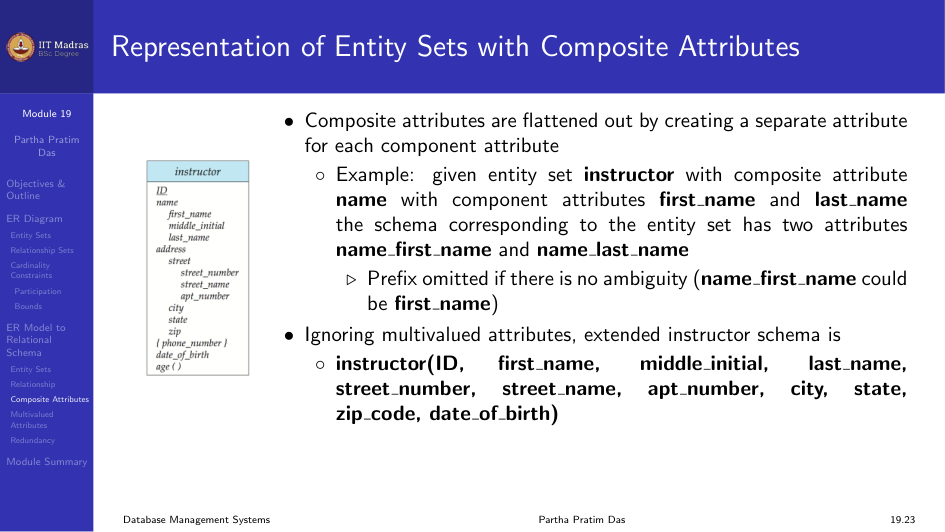
Composite attributes are flattened out by creating a separate attribute for each component attribute.
Example: given entity set instructor with composite attribute name with component attributes first_name and last_name, the schema has two attributes: name_first_name and name_last_name.
Multivalued Attributes
A multivalued attribute M of an entity E is represented by a separate schema E_M. Schema E_M has attributes corresponding to the primary key of E and an attribute corresponding to the multivalued attribute M.
Example: multivalued attribute phone_number of instructor is represented by a schema:
\text{inst\_phone} = (\text{ID}, \text{phone\_number})
Each value of the multivalued attribute maps to a separate tuple of the relation on schema E_M.
Redundancy of Schema for Relationships
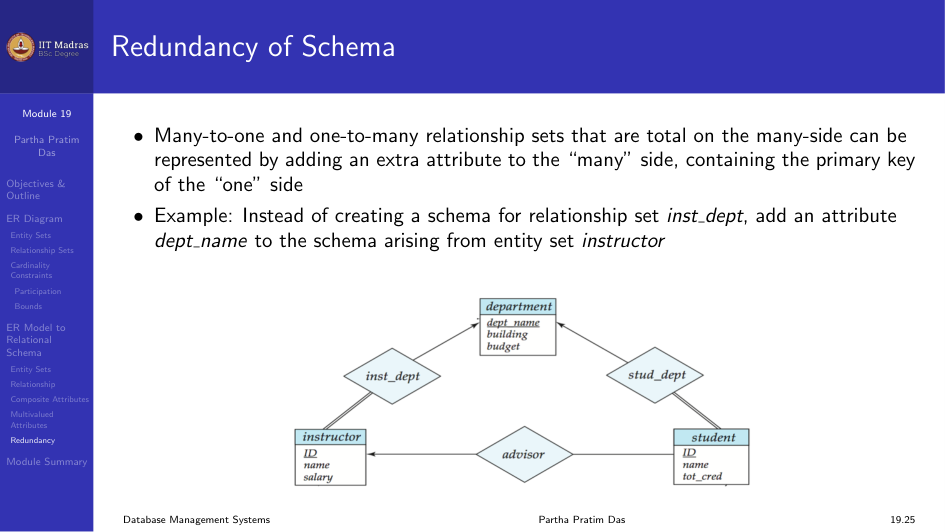
Many-to-one and one-to-many relationship sets that are total on the many-side can be represented by adding an extra attribute to the “many” side, containing the primary key of the “one” side.
Example: Instead of creating a schema for relationship set inst_dept, add an attribute dept_name to the schema arising from entity set instructor.
For one-to-one relationship sets, either side can be chosen to act as the “many” side.
If participation is partial on the “many” side, replacing a schema by an extra attribute in the schema corresponding to the “many” side could result in null values.
The schema corresponding to a relationship set linking a weak entity set to its identifying strong entity set is redundant. For example, the section schema already contains the attributes that would appear in the sec_course schema.
Module Summary
We illustrated ER Diagram notation for ER Models and discussed the translation of ER Models to relational schemas.