10.1 Transaction concept and ACID
Transaction concept
A transaction is a unit of program execution that accesses and possibly updates various data items in a database. It consists of one or more operations that logically belong together.
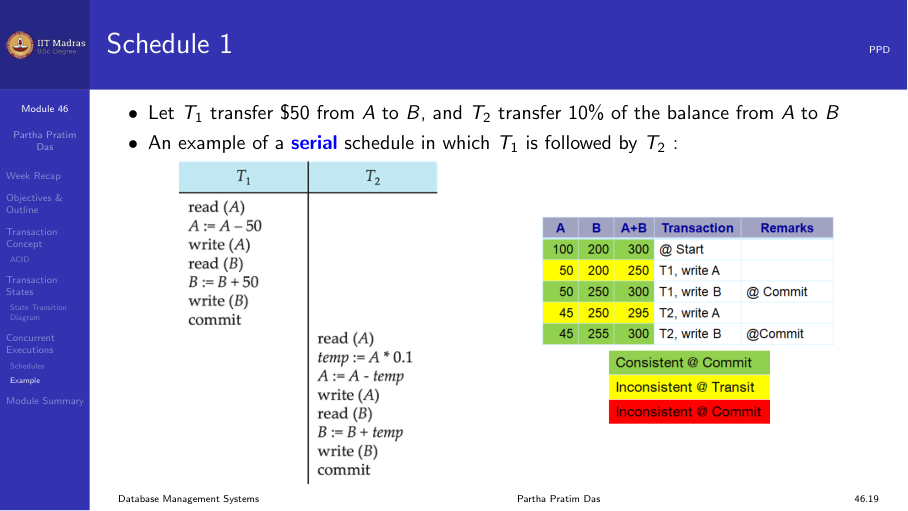
Consider a fund transfer from account A to account B:
read(A)
A := A - 50
write(A)
read(B)
B := B + 50
write(B)
This sequence of operations is a single logical unit of work. Either all steps complete successfully, or none of them should take effect.
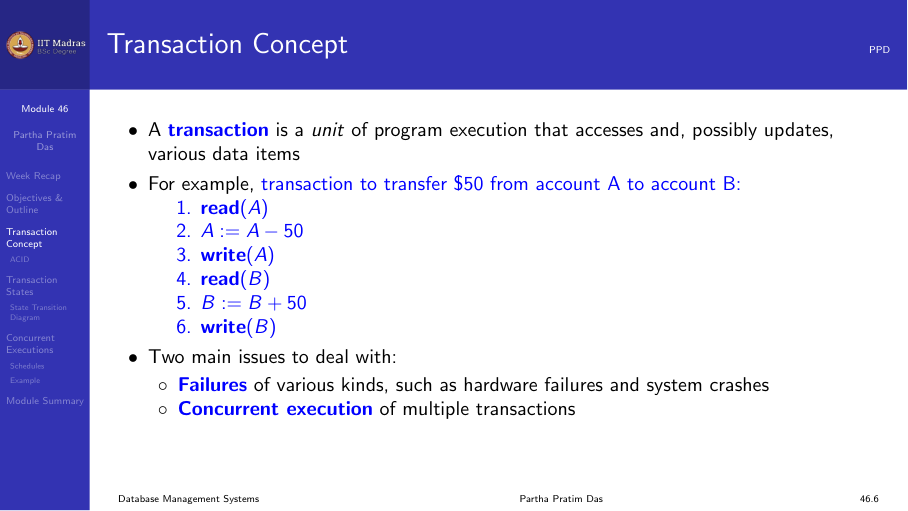
Two main issues arise with transactions:
- Failures. Hardware failures and system crashes can interrupt a transaction mid-way.
- Concurrency. Multiple transactions executing simultaneously can interfere with each other.
ACID properties
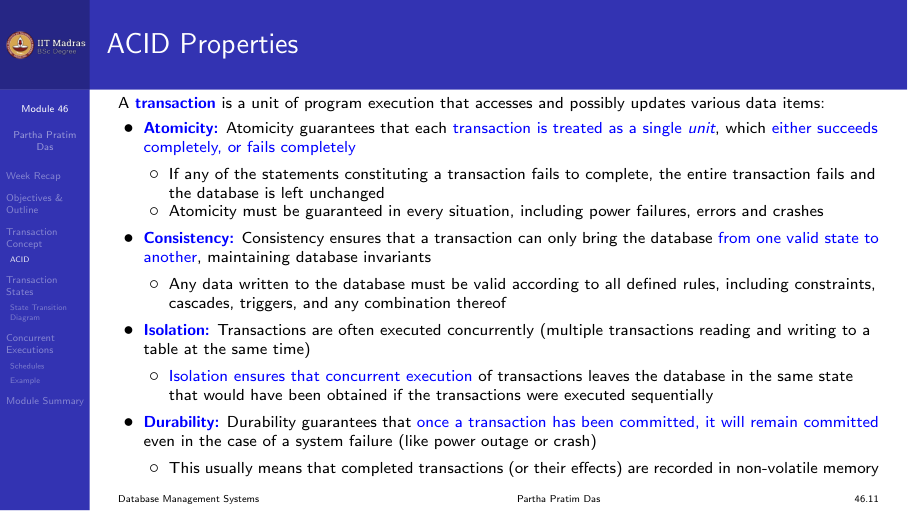
Atomicity
If the transaction fails after subtracting from A but before adding to B, $50 would be lost. The system must ensure that either both updates take effect, or neither does.
Atomicity guarantees that each transaction is treated as a single, indivisible unit. If any statement fails, the entire transaction fails and the database is left unchanged.
Consistency
The sum A + B must be unchanged by the execution of the transaction. Consistency ensures that a transaction can only bring the database from one valid state to another, maintaining all database invariants.
Consistency requirements include: - Explicit integrity constraints (primary keys, foreign keys) - Implicit integrity constraints (business rules)
Isolation
If another transaction T2 is allowed to access the partially updated database between subtracting from A and adding to B, it will see an inconsistent state where the sum A + B is less than it should be.
Isolation can be ensured trivially by running transactions serially — one after the other — but this sacrifices performance.
Durability
Once the user has been notified that the transaction has completed, the updates must persist even if there is a software or hardware failure immediately afterward.
Quick reference
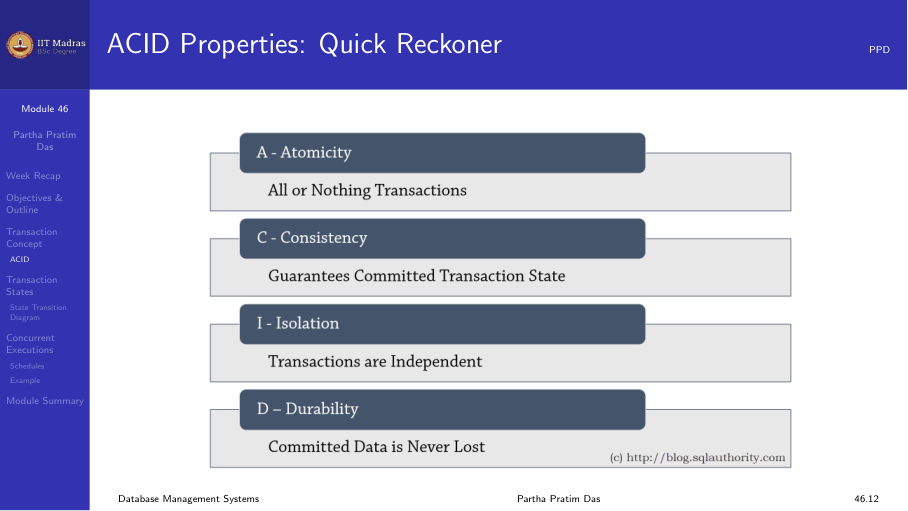
| Property | Meaning |
|---|---|
| Atomicity | All or nothing |
| Consistency | Guarantees committed transaction state |
| Isolation | Transactions are independent |
| Durability | Committed changes persist |
Transaction states
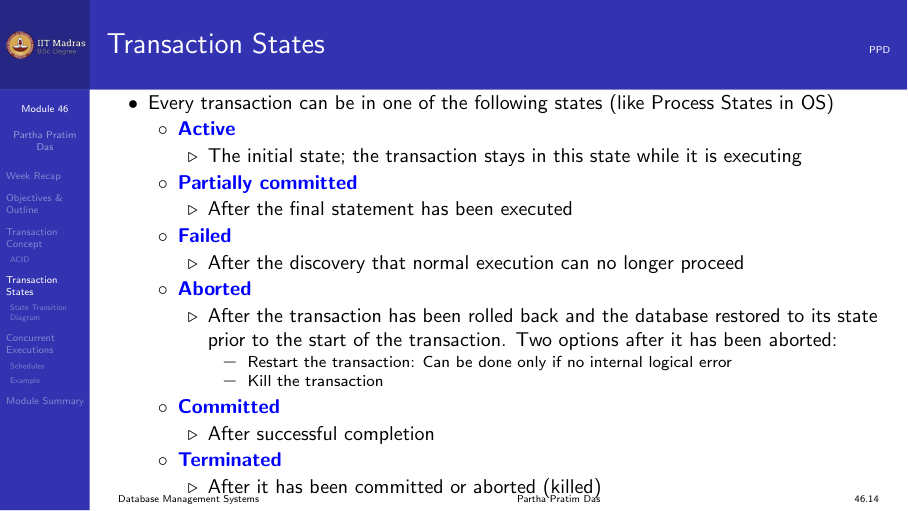
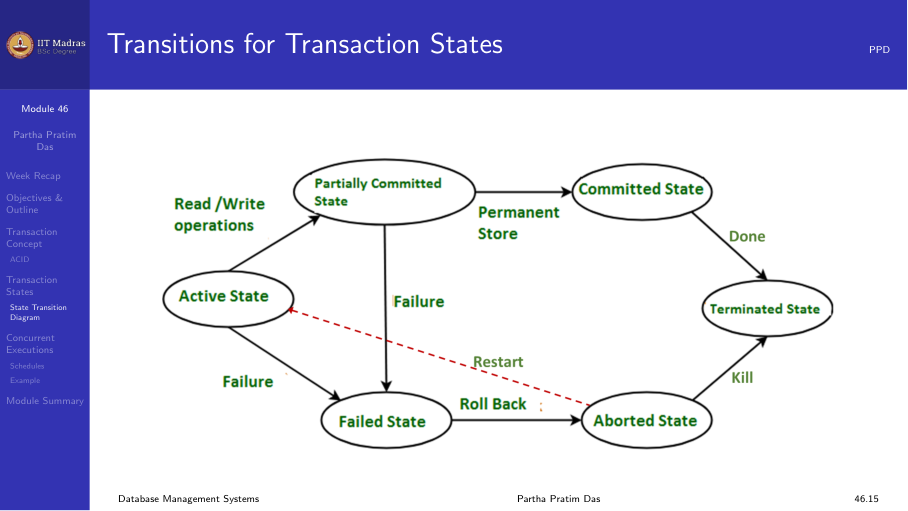
A transaction passes through several states during its execution:
- Active. The initial state. The transaction stays in this state while it is executing read and write operations.
- Partially committed. After the final statement has been executed. The transaction may still fail at this point.
- Failed. After the discovery that normal execution can no longer proceed (due to error or crash).
- Aborted. The transaction has been rolled back and the database has been restored to its state before the transaction started.
- Committed. The transaction completed successfully and all changes have been made permanent.
State transitions
- Active → Partially committed (after final statement executes)
- Active → Failed (on error or crash)
- Partially committed → Committed (on successful commit)
- Partially committed → Failed (on failure during commit)
- Failed → Aborted (after rollback completes)
A transaction that has been aborted can be restarted later.
Concurrent executions
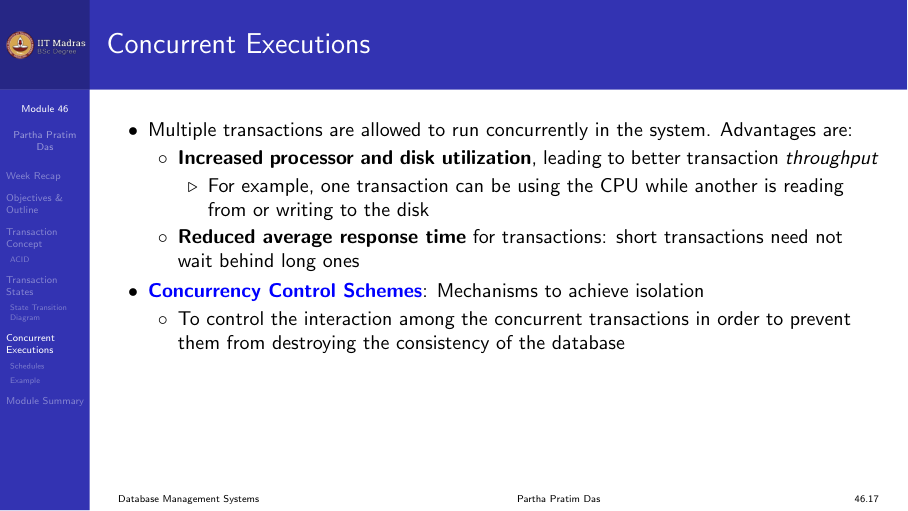
Multiple transactions are allowed to run concurrently. This provides two major advantages:
- Increased utilization. One transaction can use the CPU while another reads from or writes to disk.
- Reduced response time. Short transactions need not wait behind long ones.
These advantages improve transaction throughput.
Schedules
A schedule is a sequence of instructions that specifies the chronological order in which instructions of concurrent transactions are executed. A schedule must contain all instructions of those transactions and preserve the order of instructions within each transaction.
Serial schedules
A serial schedule executes transactions one after another. Schedule 1: T1 followed by T2. Schedule 2: T2 followed by T1. Both preserve consistency.
Concurrent schedule (serializable)
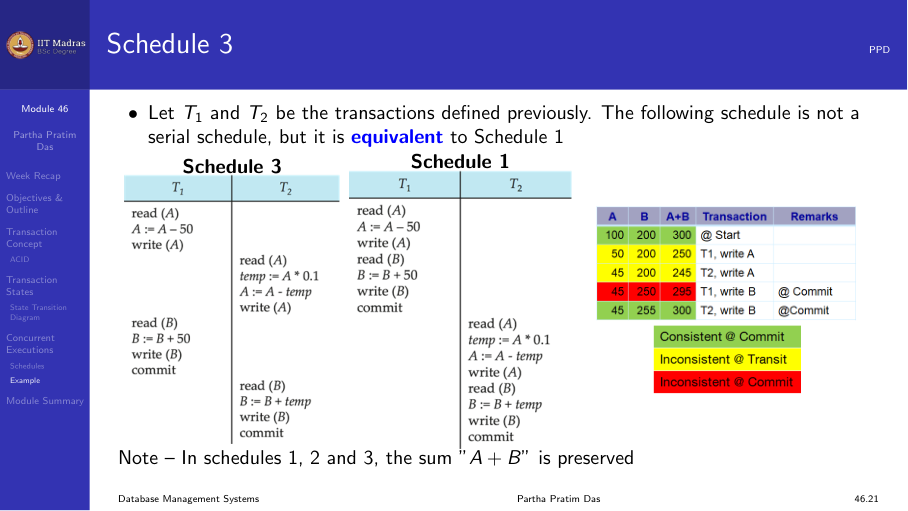
Schedule 3 interleaves instructions from T1 and T2 but produces the same result as a serial schedule. This is called a serializable schedule.
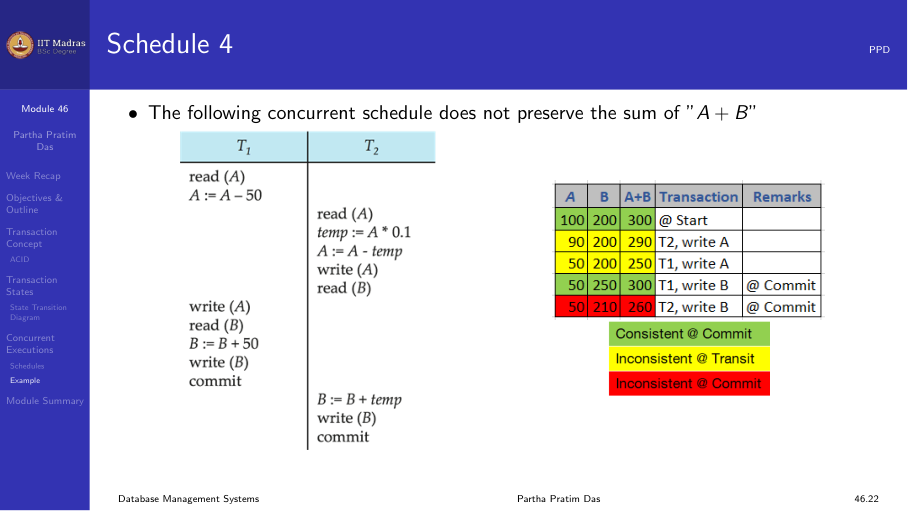
Concurrent schedule (not serializable)
Schedule 4 interleaves instructions in a way that produces an incorrect result. The sum A + B is not preserved.
Summary
- A transaction is a logical unit of work with ACID properties.
- Atomicity ensures all-or-nothing execution.
- Consistency maintains database invariants.
- Isolation prevents interference between concurrent transactions.
- Durability guarantees persistence of committed changes.
- Transactions go through states: Active, Partially Committed, Failed, Aborted, Committed.
- Concurrent execution improves throughput but requires careful scheduling.