8.5 Hash index
Introduction
A hash index is designed for fast equality searches. Given a search key value, a hash function computes the address where the record is stored. In the best case, a single hash computation and one disk access are enough to find any record.
Hash indexes do not support range queries. They are useful when the workload consists mostly of point queries: “find the record with key = X.”

Hash function
A hash function h maps a search key value K to a bucket number:
h(K) → bucket number
A good hash function has these properties:
- Deterministic. The same key always maps to the same bucket.
- Uniform. Keys are distributed evenly across all buckets.
- Fast. Computing the hash should be cheap.
Common hash functions include division (K mod B), multiplication, and cryptographic hashes (MD5, SHA) truncated to a fixed number of bits.
Static hashing
In static hashing, the number of buckets B is fixed when the index is created. Each bucket corresponds to a disk block (or a chain of blocks).
Bucket organization
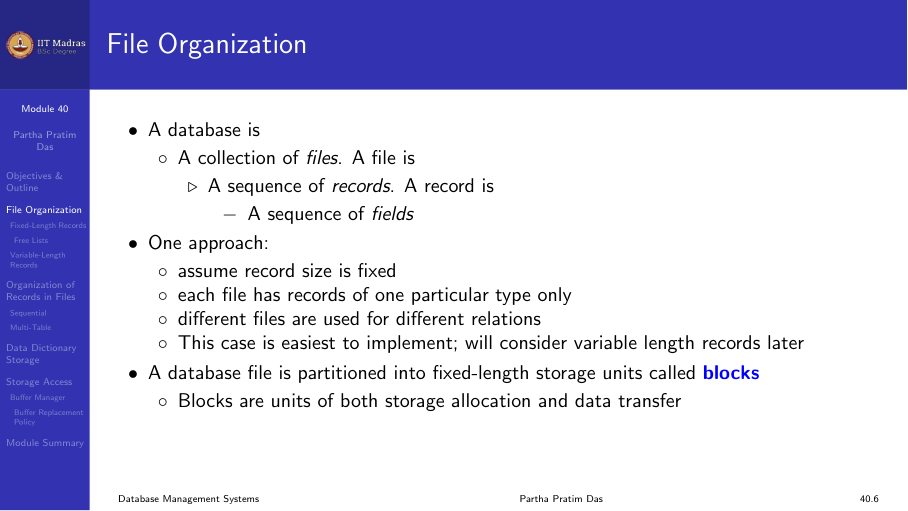
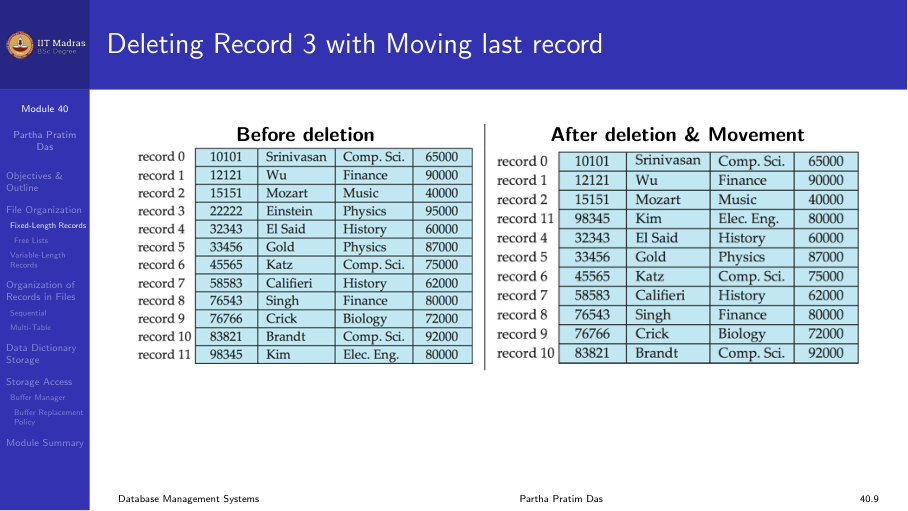
Each bucket is a disk block that stores records whose keys hash to that bucket. If a bucket overflows (multiple records hash to the same bucket), the system uses overflow blocks chained to the primary bucket block.
Searching
To find a record with key K:
- Compute h(K) to get the bucket number i.
- Read the primary block for bucket i.
- Scan the block for K.
- If not found, follow the overflow chain.
Insertion
To insert a record with key K:
- Compute h(K) to get the bucket number i.
- Read the primary block for bucket i.
- If there is space, insert the record.
- If the block is full, allocate an overflow block and link it to the chain.
Disadvantage: overflow chains
Over time, overflow chains grow long. Records accumulate in overflow blocks and the average search time increases. The problem is that the number of buckets is fixed. As the table grows, the hash function spreads records across the same B buckets, and each bucket accumulates more records.
Choosing the number of buckets
If we choose B too small, overflow chains grow quickly. If we choose B too large, space is wasted because many buckets are empty.
A common heuristic is to choose B such that each bucket holds at most two disk blocks worth of data. But this is a guess at creation time, and the guess may be wrong as the table grows.
Dynamic hashing
Dynamic hashing solves the problem of static hashing by allowing the number of buckets to grow and shrink as the table size changes. Two common forms are extendible hashing and linear hashing.
Extendible hashing
Extendible hashing uses a directory of pointers to buckets. The directory can grow as needed, and buckets can split when they overflow.
Structure
- A directory is an array of pointers to buckets. The directory size is 2^d, where d is the global depth.
- A bucket stores records. Each bucket has a local depth d’ ≤ d.
- The hash function produces an integer. The lower d bits of the hash determine the directory entry used.

Searching
To find a record with key K:
- Compute h(K) to get a bit string.
- Take the lower d bits as the directory index.
- Follow the directory pointer to the bucket.
- Scan the bucket for K.
Insertion
To insert a record with key K:
- Compute h(K).
- Use the lower d bits to find the directory entry and bucket.
- If the bucket has space, insert.
- If the bucket is full:
- If the bucket’s local depth d’ < global depth d, split the bucket into two. Redistribute records using (d’ + 1) bits. Increment local depth. Update directory entries.
- If the bucket’s local depth d’ = global depth d, double the directory. Increment d. Then split the bucket as in (a).
Directory doubling
When the directory doubles, its size increases from 2^d to 2^(d+1). Each old entry is duplicated: entry i is copied to entries i and i + 2^d. Then the bucket that caused the split is split, and its two new buckets get different entries in the directory.
Advantages and disadvantages
Advantages: - No overflow chains. Buckets are split when they overflow. - Performance remains consistent as the table grows. - Space utilization is reasonable.
Disadvantages: - The directory can become large for non-uniform hash distributions. - Directory doubling is expensive (though infrequent).
Linear hashing
Linear hashing is another dynamic hashing method. Unlike extendible hashing, it does not use a directory. Instead, it grows buckets one at a time in a linear fashion.
How it works
Linear hashing uses a family of hash functions h_0, h_1, h_2, … where:
h_i(K) = h(K) mod (2^i × B_0)
Here B_0 is the initial number of buckets. The system maintains a pointer p that indicates which bucket will split next.
Insertion
- Compute h_level(K) to find the bucket.
- If the bucket is not full, insert.
- If the bucket is full, handle overflow (chain or split).
- Split bucket p: redistribute its records using the next hash function. Create a new bucket at the end.
- Increment p. If p reaches 2^level × B_0, reset p to 0 and increment level.
Splitting one bucket at a time
Unlike extendible hashing, which splits only the overflowing bucket, linear hashing splits buckets in a fixed order regardless of which bucket overflowed. Over time, every bucket gets split, keeping the load balanced.
Searching
To find a key K:
- Compute h_level(K). If the result is less than p, use h_{level+1}(K) instead (because the bucket has already split).
- Read the bucket and scan for K.
Advantages
- No directory. Space overhead is lower than extendible hashing.
- Gradual growth. Buckets are split one at a time.
- Good for concurrent access.
Hash index versus B+ tree
| Property | Hash index | B+ tree |
|---|---|---|
| Equality search | Very fast (O(1)) | Fast (O(log n)) |
| Range search | Not supported | Very fast |
| Insert | Fast | Fast |
| Delete | Fast | Fast |
| Space | Depends on load factor | Moderate |
| Use case | Point queries only | General purpose |
In practice, B+ trees are used more often because they support both equality and range queries. Hash indexes are used for specific workloads where only equality searches matter, such as in-memory key-value stores.
Summary
- Hash indexes provide fast equality searches using a hash function.
- Static hashing has a fixed number of buckets; overflow chains grow as the table grows.
- Extendible hashing uses a directory that doubles as needed.
- Linear hashing grows buckets one at a time without a directory.
- Hash indexes do not support range queries.
- B+ trees are more versatile and are the default index in most systems.