4.3 Entity-Relationship Model/1
The Entity-Relationship (E-R) Model is used in the designing phase of a database. It is a model that helps us visualize the data as a set of entities and the relations that exist between them.
An entity is a real-world object. In the Student Database, entities are students, instructors, and departments.
Attributes
An attribute is a property associated with an entity. There are several types of attributes.
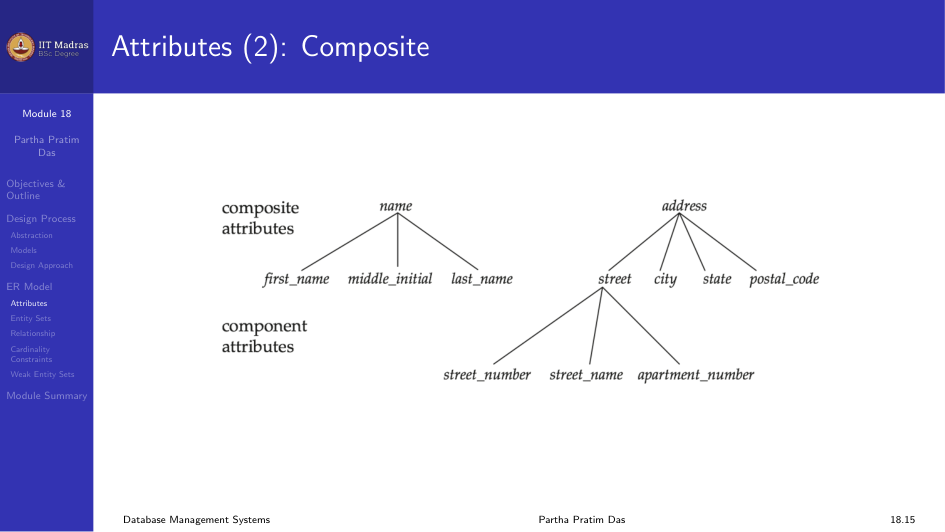
Simple and Composite (Compound) attributes. A simple attribute cannot be divided further. A composite attribute can be divided into sub-units. For example, the attribute
namecan be divided intofirst_name,middle_initial, andlast_name.Single-valued and Multi-valued attributes. A single-valued attribute takes only one value. A multi-valued attribute takes multiple values, such as phone numbers: 123456789, 234565678.
Derived attributes. An attribute that can be computed from other stored attributes. For example,
agecan be calculated fromdate_of_birth. Age becomes the derived attribute.
The domain is the set of all values that an attribute can take.
An entity set can be taken as a relation with a set of entities, which are the set of attributes.
Types of Entity Sets
There are two types of entity sets.
Strong Entity Set
A strong entity set is an entity set that contains sufficient attributes to uniquely identify all its entities. A primary key exists for a strong entity set. The primary key is represented by underlining it. Each entity is a row. We can take each row as an object.
Weak Entity Set
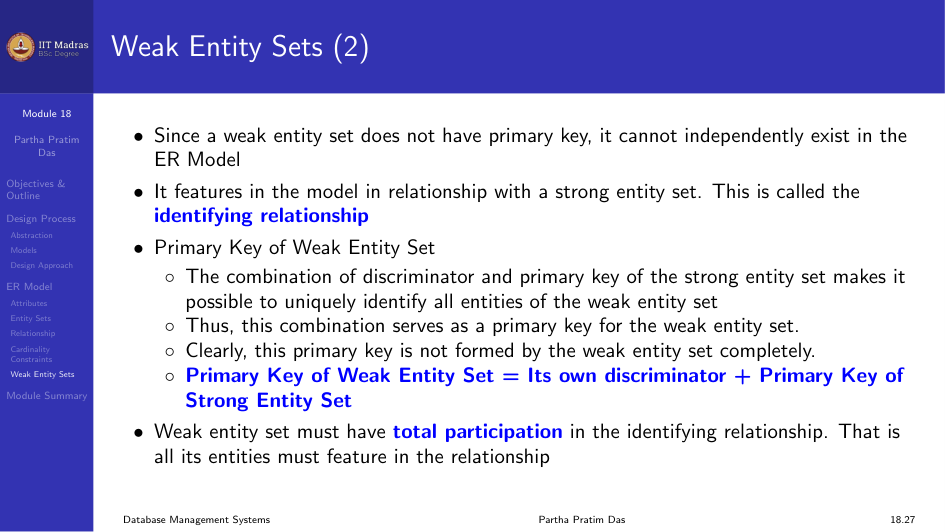
A weak entity set is an entity set that does not contain sufficient attributes to uniquely identify all its entities. A weak entity set does not have a primary key, but it has a partial key called a discriminator, which is represented using dotted lines.
We cannot uniquely identify a row in a weak entity set by itself. So we link the partial key with the primary key of a strong entity. This kind of relationship is called an identifying relationship.
The primary key of a weak entity set is:
\text{Primary Key} = \text{Discriminator} + \text{Primary Key of Strong Entity Set}
A weak entity set must have total participation in the identifying relationship. All its entities must feature in the relationship.
Example
Strong entity set: Building(building_no, building_name, address). Here building_no is the primary key.
Weak entity set: Apartment(door_no, floor). Here door_no is the discriminator because door number alone cannot identify an apartment uniquely. There may be several other buildings with the same door number.
Relationship: BA between Building and Apartment. By total participation in BA, each apartment must be present in at least one building. Building has partial participation because there may be buildings with no apartments.
Primary key of Apartment = building_no + door_no
Relationship Sets
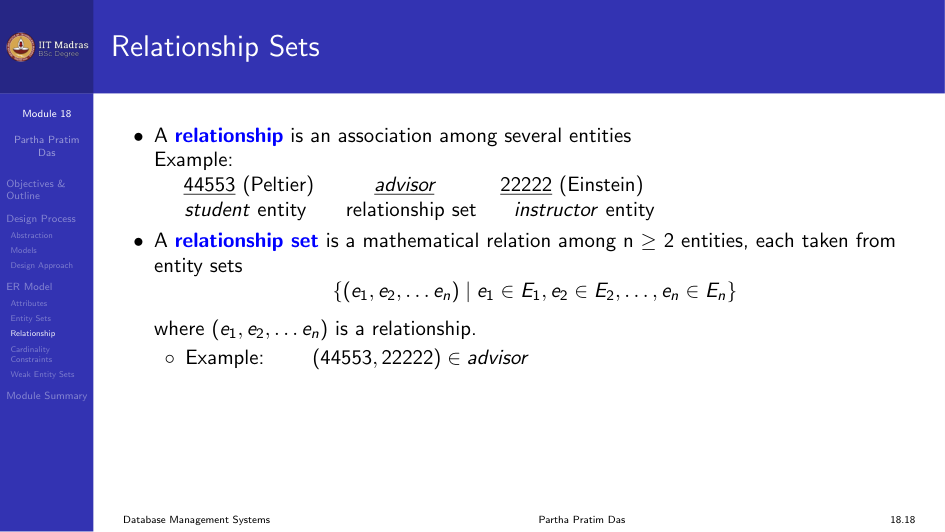
Relationships are very important for designing the schema of the database. A relationship is an association among entities. A relationship set is a set of relationships of the same type.
For example, the relationship advisor associates a student with an instructor.
Degree of a Relationship
Most relationship sets are binary (involving two entity sets). Relationships between more than two entity sets are rare. For example, the project_guide relationship is a ternary relationship between instructor, student, and project.
Mapping Cardinality Constraints
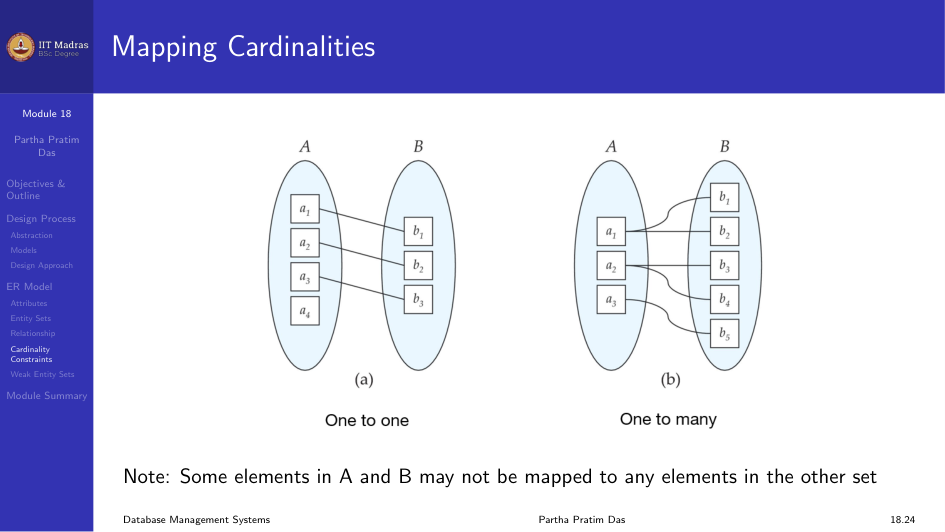
For a binary relationship set, the mapping cardinality must be one of the following types.
One-to-One Relationship. Each instructor has at most one student (1 or less than 1). Each student has at most one instructor (1 or less than 1).
One-to-Many Relationship. Each instructor has one or many students. Each student has at most one instructor (meaning a student can have 1 or zero instructors).
Many-to-One Relationship. Each instructor has at most one student. Each student has one or many instructors.
Many-to-Many Relationship. Each instructor has one or many students. Each student has one or many instructors. For a Many-to-Many relationship, we need three tables to represent an entity set. There is an intermediate table that references or links the many-to-many relationship between two tables.
Participation Constraints
Total Participation (indicated by a double line) means that every entity in the entity set participates in at least one relationship in the relationship set. For example, the participation of student in the advisor relation is total because every student must have an associated instructor.
Partial Participation means some entities may not participate in any relationship in the relationship set. For example, the participation of instructor in the advisor relation is partial.
ER Diagram Notation Summary
- Rectangles represent entity sets.
- Attributes are listed inside the rectangle.
- An underline indicates the primary key attribute.
- A diamond represents a relationship set.
- Double lines indicate total participation.
- A double rectangle represents a weak entity set.
- A double diamond represents a weak entity set or an identifying relationship.
Ternary Relationship
A ternary relationship is a relationship between three entity sets.
Overlapping and Partial
In overlapping specialization, an entity can be in both the relations. In partial specialization, an entity may not be in any of the relations.
Module Summary
We introduced the Entity-Relationship Model for real-world representation with entities, entity sets, attributes, and relationships.