7.1 Application programs and architecture
Introduction
We have covered the entire gamut of relational databases — how to get to a good design, how to normalize, how to reduce redundancy. Now we move forward to the applications that are built with these databases in the backend.
The end goal of all database design is to build efficient, secure, and scalable applications. Despite the wide variety of application domains, there is a strong commonality in architecture across all of them.
The three-layer architecture
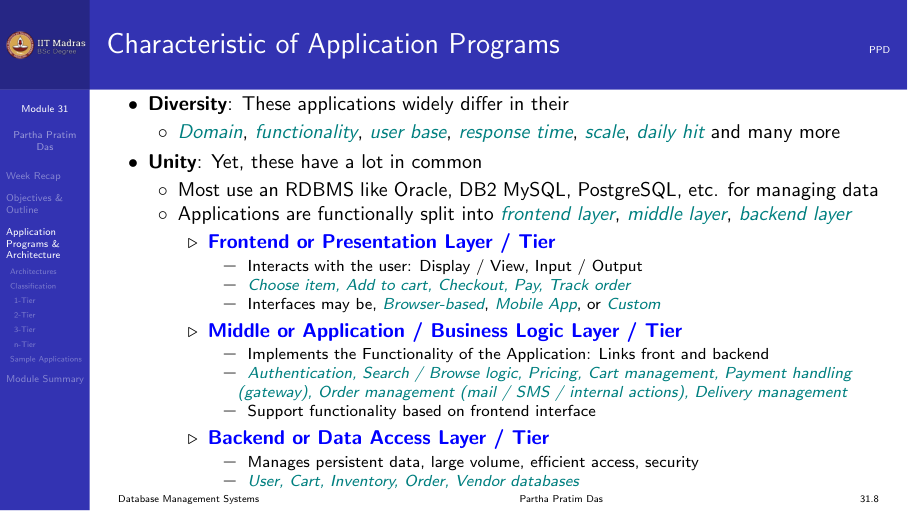
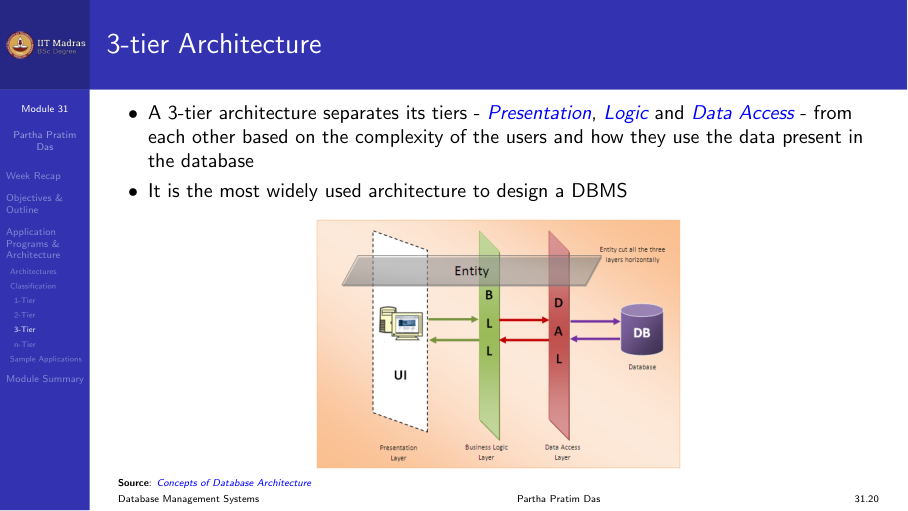
Every web application can be split into three conceptual layers:
Frontend (presentation layer). The layer that interacts directly with the user through a browser or mobile app. It handles user input, displays results, and manages workflows like login, search, checkout, and payment.
Middle layer (application / business logic layer). Implements the functionality of the application. It links the frontend and backend layers. This includes authentication, search logic, pricing, cart management, payment gateway handling, order management, and delivery tracking.
Backend (data access layer). Manages persistent data in a database (Oracle, MySQL, PostgreSQL, etc.). This is the part of the database that we have been learning so far — tables, indexes, queries, normalization.
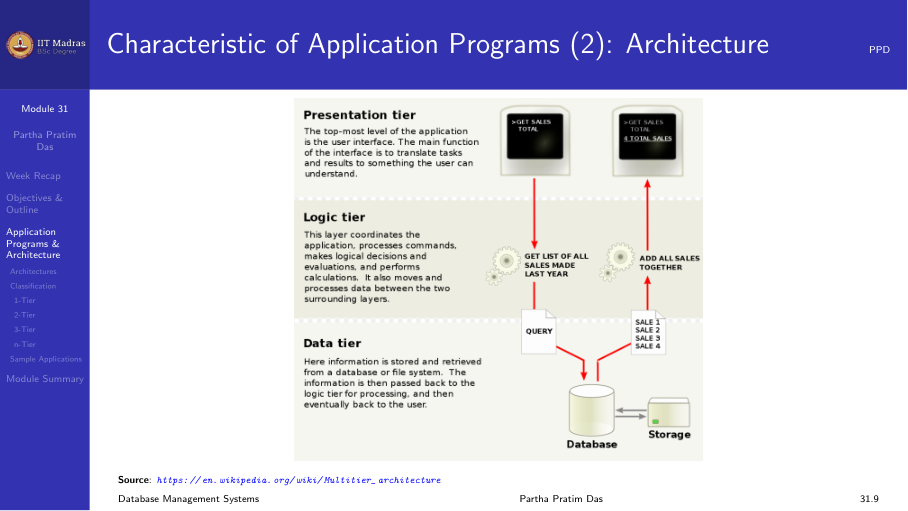
How the layers work together
The frontend makes a request (e.g. through HTTP). This goes to the application layer, which translates it into SQL queries for the database. The database returns table results, which the application layer converts into a format the frontend can display (e.g. HTML).
Presentation layer: MVC architecture
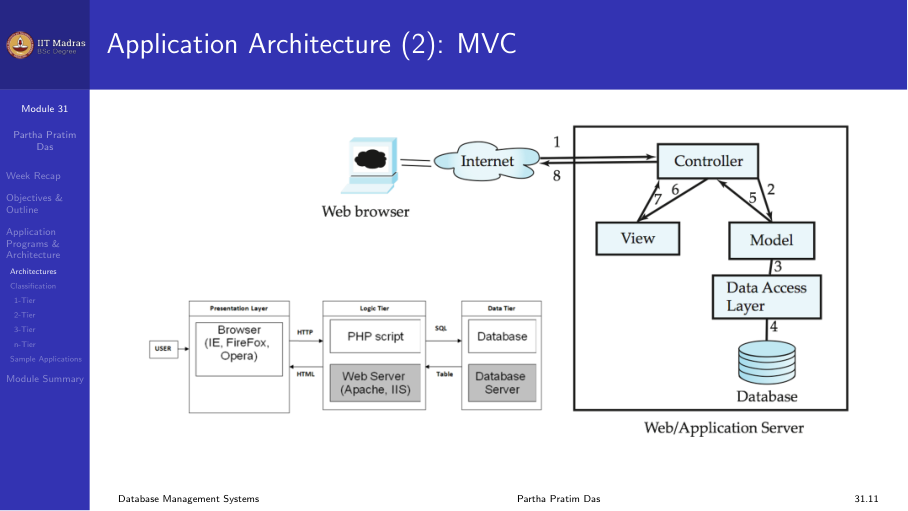
The frontend layer typically follows the MVC (Model-View-Controller) architecture:
- Model. The part of business logic that has to be presented in the frontend, e.g., authentication checks, data validation.
- View. How information is displayed on the screen — checkboxes, edit boxes, radio buttons, static text.
- Controller. Manages the view and model by receiving messages, executing actions, and returning a view to the user.
Business logic layer
This layer provides a high-level view of the data. It keeps an object data model corresponding to the relational tables and relationships. It hides the details of the storage schema and can implement complex business rules that cannot be implemented in the database alone.
For example, a business rule like “a student can enroll in a class only if she has completed prerequisites and paid her tuition fees” is implemented here. The database knows the prerequisites and fee status, but cannot make the business decision — that belongs in the business logic layer.
Object-relational mapping
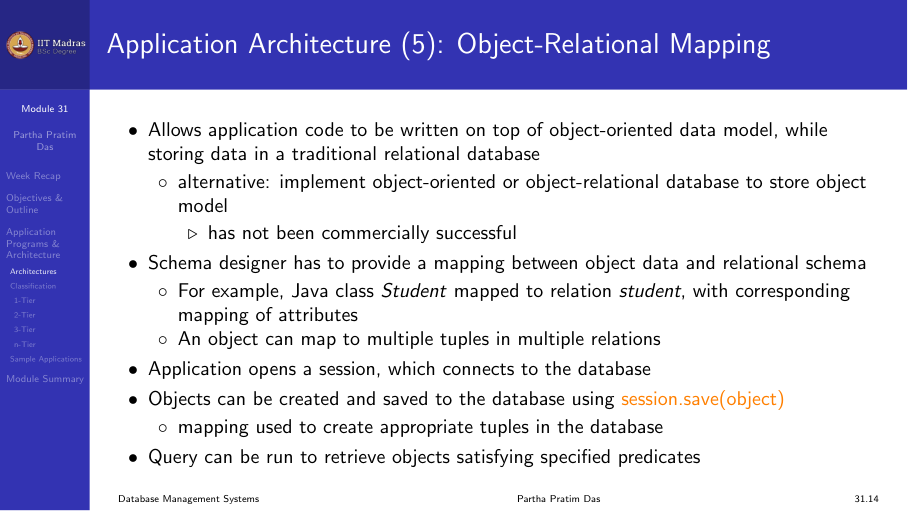
The business logic layer needs an object-oriented view of data, while the database has a relational view. This requires object-relational mapping (ORM), where each entity (e.g., Student, Instructor, Course) has a corresponding class in the programming language and a corresponding table in the database.
Data access layer
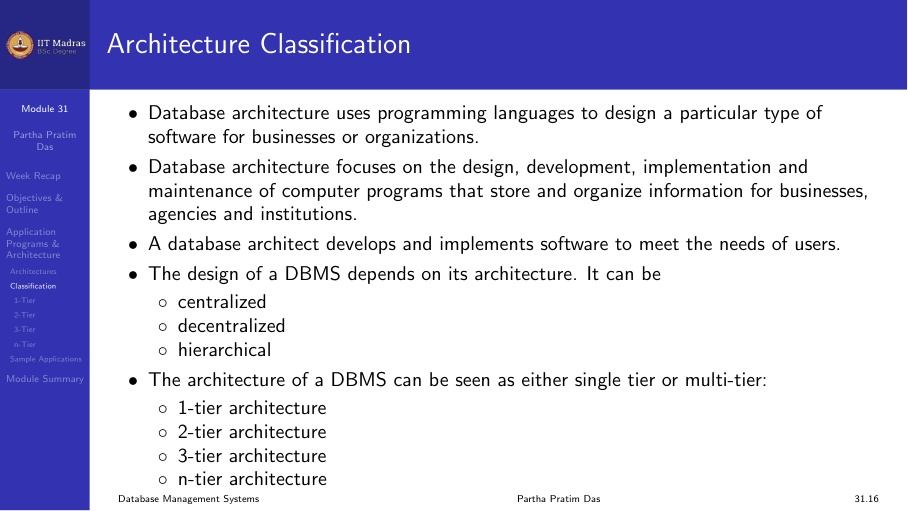
The data access layer interfaces between the business logic layer and the underlying database. It provides a mapping between the object models in the business logic layer and the relational model that the database maintains.
There is a paradigm mismatch: the business logic uses an object-oriented language (Java, Python, C++), while the database uses SQL. The data access layer bridges this gap.
Evolution of architectures
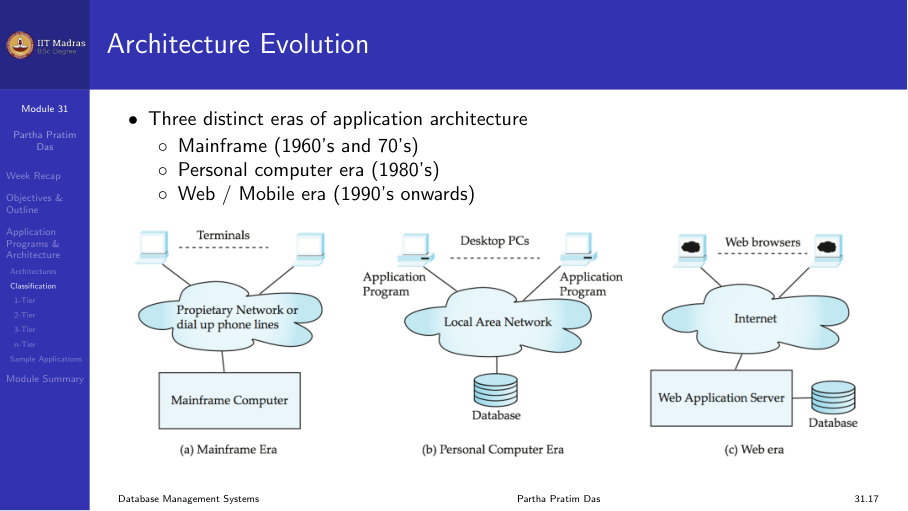
The three-tier architecture did not happen overnight. It evolved over decades:
- 1970s: Mainframes. Everything was centralized in a single huge, expensive computer. This was one-tier.
- 1980s: Personal computers + LAN. Basic data distribution concepts emerged. This introduced two-tier client-server architecture.
- 1990s onward: Internet / Web. Three-tier and N-tier architectures became the norm, with separate presentation, application, and database servers.
- 2000s onward: Mobile. Heavy shift to mobile-based access with Android and iOS platforms.
One-tier architecture
All three layers run on the same computer. Simple but not very useful for real-world applications.
Two-tier architecture (client-server)
The client tier has the frontend, and the database tier has the database layer. The application layer is distributed between them. This is better than one-tier but does not give clean separation.
Three-tier architecture
The presentation, business logic, and data access layers are separated into distinct tiers. This is the standard for most modern web applications.
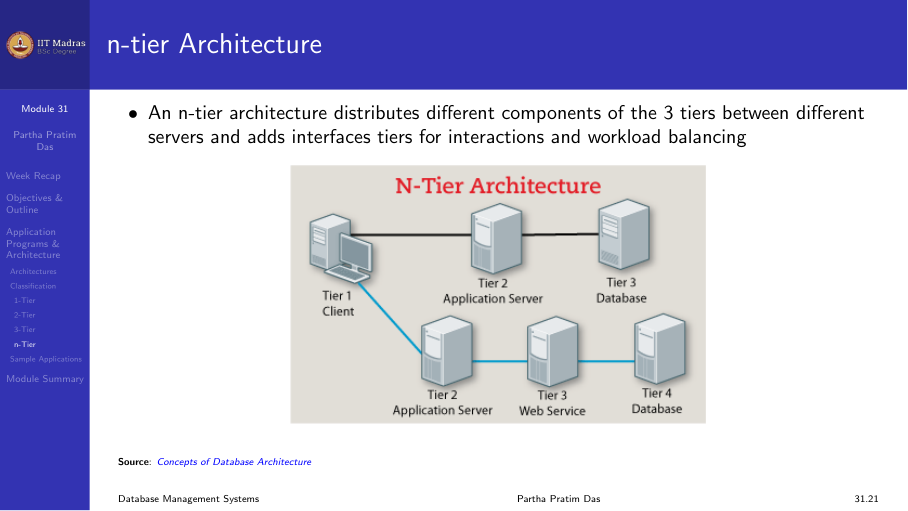
N-tier architecture
Functionally similar to three-tier, but in implementation there can be multiple application servers, multiple database servers, web services, and other components. The tiering is done from an implementation and technology perspective.
Sample applications
Every application — web mail, e-commerce, net banking, ride sharing — follows the same three-tier architecture. For example, in web mail:
- Presentation layer: login, mail list, view mail, compose, filter.
- Business logic layer: user authentication, connect to mail server, encryption/decryption.
- Data layer: mail users table, address book, mail items.
Summary
All data-intensive web applications share the same fundamental three-tier architecture: presentation, business logic, and data access. The database architect designs and implements this architecture, and the specific details are filled in by application developers.