11.4 Recovery with early lock release and planning
Recovery with early lock release
Standard two-phase locking requires that all locks be held until the transaction commits. However, some data structures (like B+ trees) can benefit from releasing locks early to increase concurrency.
B+ tree concurrency control algorithms often allow locks to be released early, in a non-two-phase manner. As a result, it is possible that after a transaction releases a lock, another transaction modifies the same data item. This complicates recovery.
Logical undo
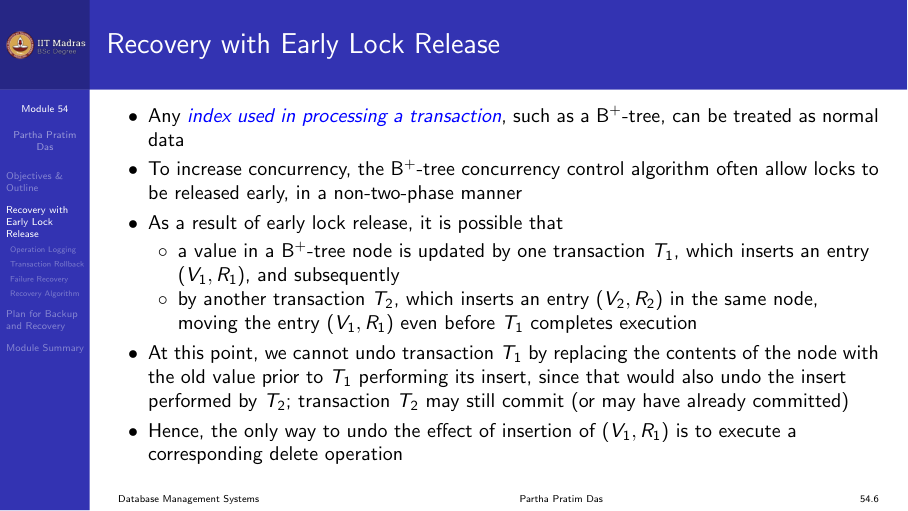
When locks are released early, operations like B+ tree insertions and deletions cannot be undone by simply restoring old values (physical undo). Once a lock is released, other transactions may have updated the B+ tree, and restoring old values would corrupt the structure.
Instead, insertions are undone by executing a deletion operation, and deletions are undone by executing an insertion operation. This is called logical undo — the inverse operation is applied rather than restoring the old state.
Support for high-concurrency locking techniques that release locks early requires:
- Logical undo. Reverse operations by executing inverse operations.
- Repeating history. Recovery executes the same operations again to reach the current state.
Physical redo
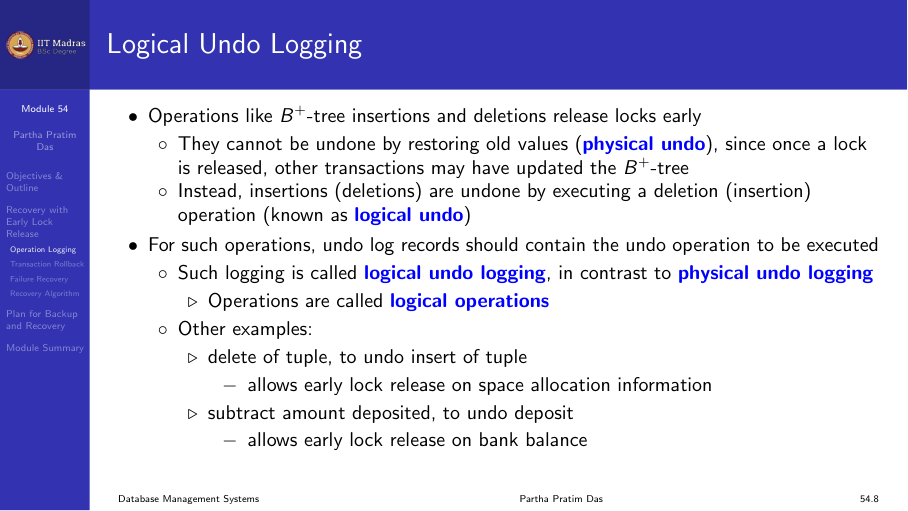
While undo is logical, redo is physical. Redo information is logged physically (the new value for each write) even for operations with logical undo.
Logical redo would be very complicated because the database state on disk may not be “operation consistent” when recovery starts. Physical redo logging does not conflict with early lock release.
Operation logging
When an operation starts, the system logs <Tᵢ, Oⱼ, operation-begin>. Here Oⱼ is a unique identifier of the operation instance.
While the system executes the operation, it creates update log records in the normal fashion for all updates performed by the operation.
When the operation completes, it logs <Tᵢ, Oⱼ, operation-end, U>, where U is the logical undo information.
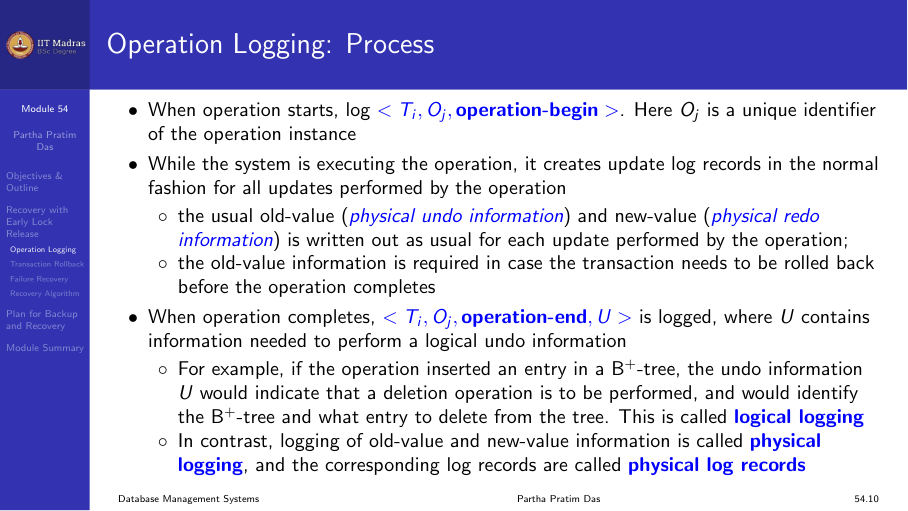
Example: Insert into a B+ tree
Insert of (key, record-id) pair (K5, RID7) into index I9:
<T₁, O₁, operation-begin>
<T₁, X, 10, K5>          Physical redo of steps in insert
<T₁, Y, 45, RID7>
<T₁, O₁, operation-end, (delete I9, K5, RID7)>
The operation-end record contains the logical undo information: to undo this insert, delete (K5, RID7) from I9.
Crash during operation
If a crash or rollback occurs before the operation completes:
- The operation-end log record is not found.
- Physical undo information is used to undo the operation.
If a crash occurs after the operation completes:
- The operation-end log record is found.
- Logical undo is used to reverse the operation.
Transaction rollback with logical undo
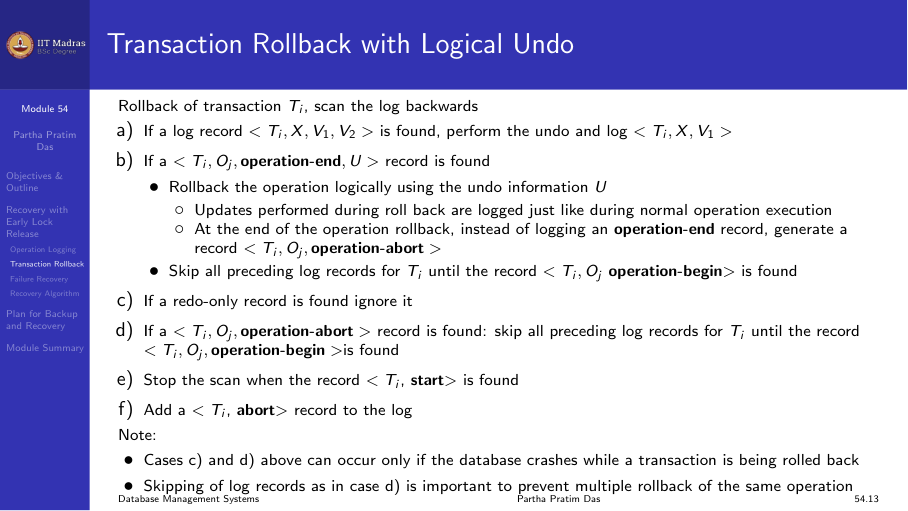
During rollback of transaction Tᵢ, scan the log backwards:
- If a log record
<Tᵢ, X, V₁, V₂>is found, perform physical undo and log<Tᵢ, X, V₁>. - If a
<Tᵢ, Oⱼ, operation-end, U>record is found, roll back the operation logically using the undo information U. Updates during logical rollback are logged normally.
Recovery algorithm with logical undo
The algorithm is similar to the standard recovery algorithm, with changes to how the undo phase handles operation log records:
Redo phase: Scan log forward from the last checkpoint to the end. Repeat history by physically redoing all updates of all transactions.
Undo phase: Scan log backwards. For transactions in undo-list, process log records as described for logical undo.
Plan for backup and recovery
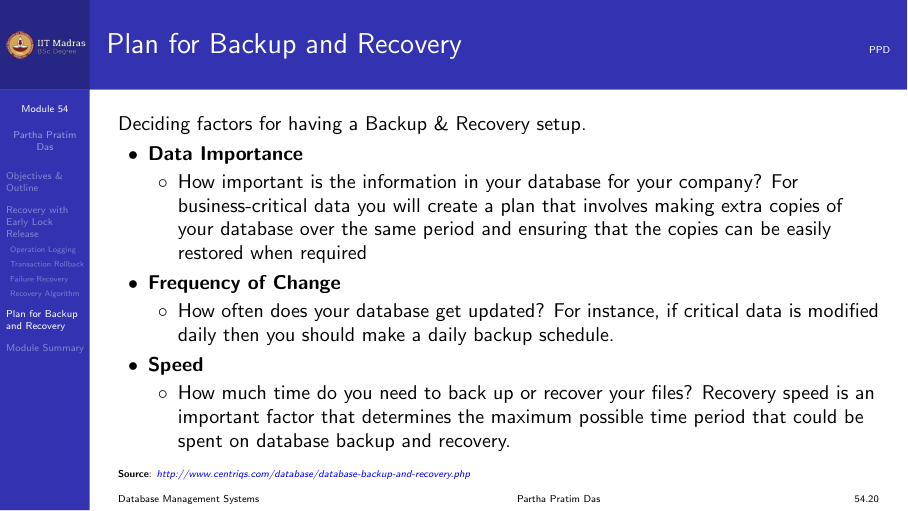
Planning for backup and recovery involves several factors:
Data importance
How important is the information in your database for your company? For business-critical data, create a plan that involves extra copies and ensures that copies can be easily restored.
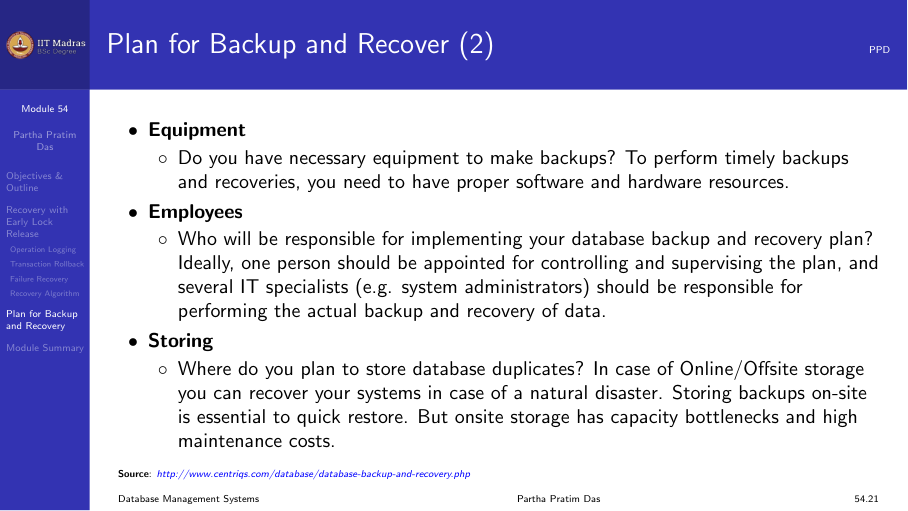
Equipment
Do you have the necessary equipment to make backups? To perform timely backups and recoveries, you need proper software and hardware resources.
Employees
Who will be responsible for implementing your database backup and recovery plan? Designated personnel should be trained in backup procedures and recovery operations.
Key considerations
- Recovery time objective (RTO). How long can the system be down?
- Recovery point objective (RPO). How much data loss is acceptable?
- Backup frequency. How often should backups be taken?
- Storage location. Should backups be on-site, off-site, or both?
- Testing. Regularly test that backups can be restored successfully.
Summary
- Early lock release improves concurrency but complicates recovery.
- Logical undo reverses operations by executing inverse operations.
- Operation logging tracks the begin and end of each operation.
- Physical redo and logical undo can coexist.
- Backup and recovery planning should consider data importance, equipment, personnel, RTO, and RPO.