10.3 Recoverability and TCL
What is recovery?
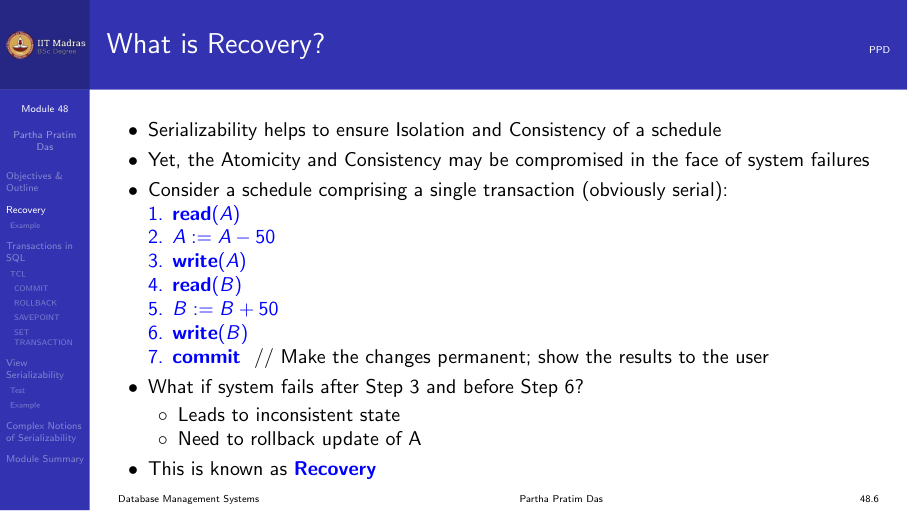
Serializability helps ensure isolation and consistency in concurrent schedules. However, atomicity and consistency can still be compromised when the system fails.
Consider a single transaction:
read(A)
A := A - 50
write(A)
read(B)
B := B + 50
write(B)
What happens if the system crashes after writing A but before writing B? The database would be inconsistent — $50 would be lost. Recovery protocols ensure that such failures do not corrupt the database.
Recoverable schedules
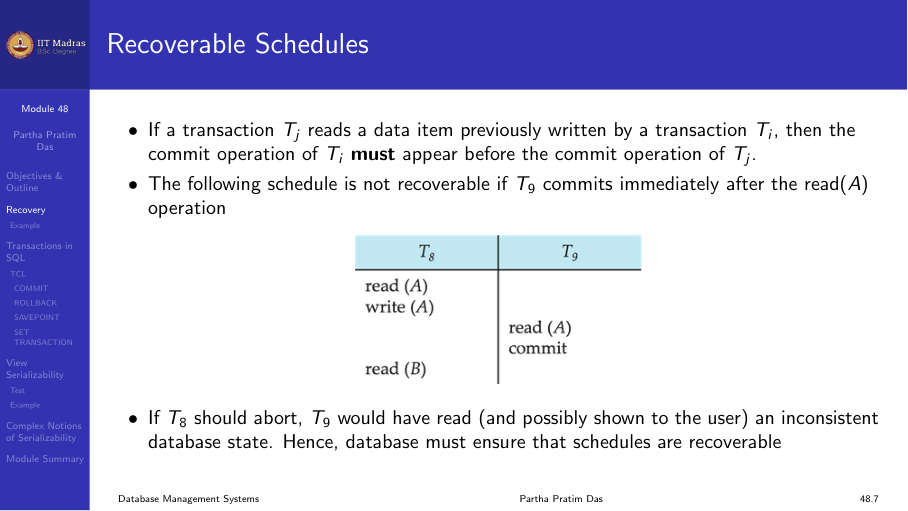
A schedule is recoverable if, whenever a transaction Tⱼ reads a data item previously written by a transaction Tᵢ, the commit operation of Tᵢ appears before the commit operation of Tⱼ.
T1: write(A) → commit
T2: read(A) → commit (must happen after T1 commits)
If T2 commits before T1 and then T1 aborts, T2 has read a value that never existed (a dirty read). This must be prevented.
Example: irrecoverable schedule
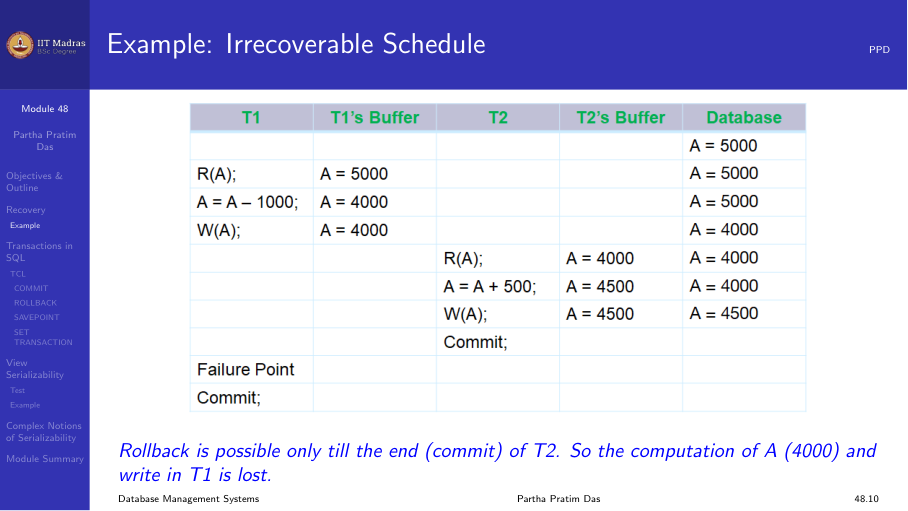
     T1            T2
     read(A)
     A = A - 1000
     write(A)      read(A)      → T2 reads uncommitted value
     abort         commit       → T2 commits based on uncommitted data
                              → Irrecoverable!
T2 reads A=4000 after T1 wrote it but before T1 committed. T1 then aborts, rolling back to A=5000. But T2 has already committed using A=4000. The database is inconsistent.
Cascading rollbacks
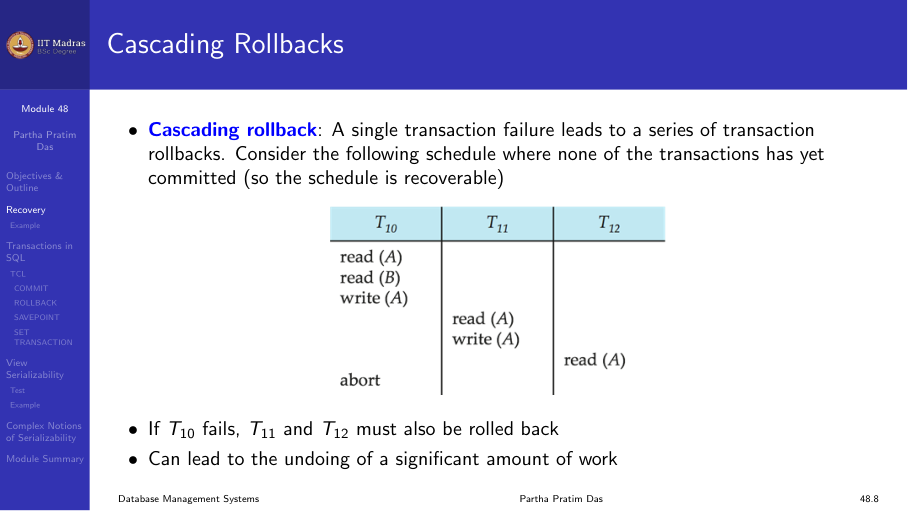
A cascading rollback occurs when a single transaction failure leads to a series of transaction rollbacks.
     T1            T2            T3
     write(A)
                   read(A)
                   write(B)
                                 read(B)
                                 write(C)
     abort
                   must abort    must abort
When T1 aborts, T2 must abort because it read A written by T1. Then T3 must abort because it read B written by T2. The rollback cascades through the chain of dependent transactions.
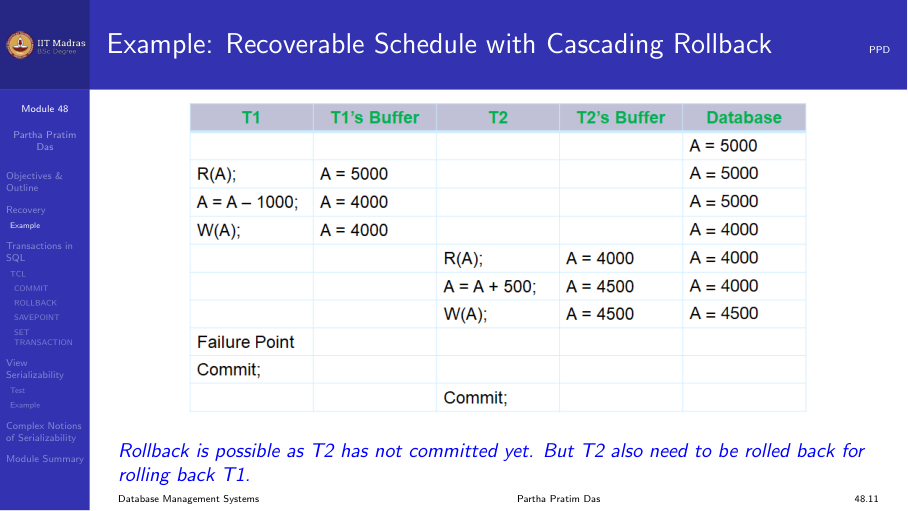
Recoverable schedule with cascading rollback
T1: write(A) → (no commit)
T2: read(A)  → (no commit)
T1: commit
T2: commit
This schedule is recoverable (T1 commits before T2), but if T1 aborts before committing, T2 must also be rolled back. This is cascading but recoverable.
Cascadeless schedules
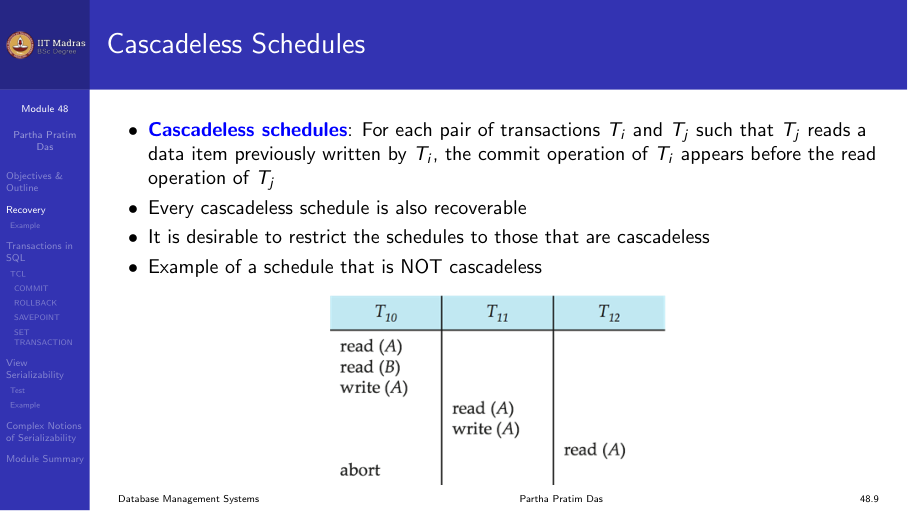
A schedule is cascadeless if, for each pair of transactions Tᵢ and Tⱼ such that Tⱼ reads a data item previously written by Tᵢ, the commit operation of Tᵢ appears before the read operation of Tⱼ.
In other words, a transaction can only read data items that have already been committed. This eliminates cascading rollbacks entirely.
Every cascadeless schedule is also recoverable, but not every recoverable schedule is cascadeless.
| Property | Tⱼ reads after Tᵢ writes | Tⱼ commits after Tᵢ commits |
|---|---|---|
| Recoverable | — | Required |
| Cascadeless | Required (commit before read) | Required |
Transaction definition in SQL
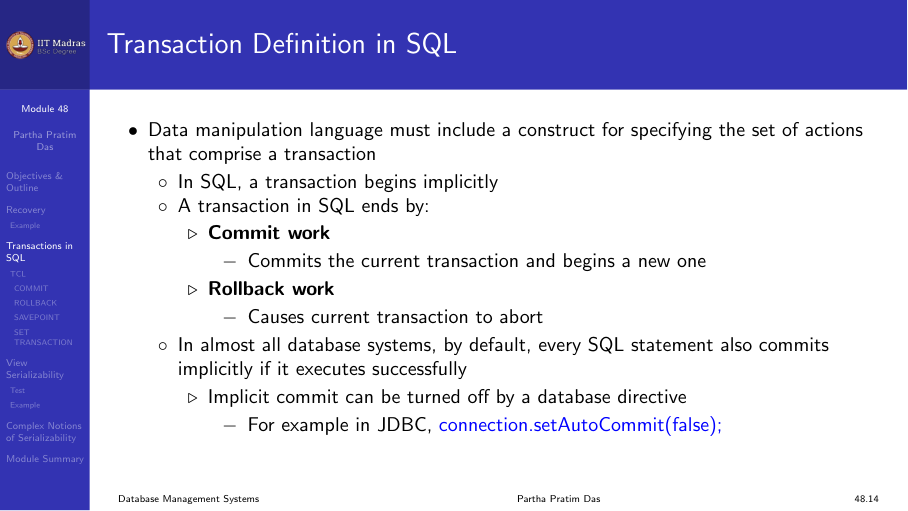
SQL provides constructs for defining and controlling transactions.
Beginning a transaction
In SQL, a transaction begins implicitly when a user executes a statement that accesses the database. There is no explicit BEGIN TRANSACTION statement (though some databases support it).
Ending a transaction
A transaction in SQL ends by:
- COMMIT. Saves all changes made by the transaction to the database.
- ROLLBACK. Undoes all changes made by the transaction since the last COMMIT or ROLLBACK.
TCL commands
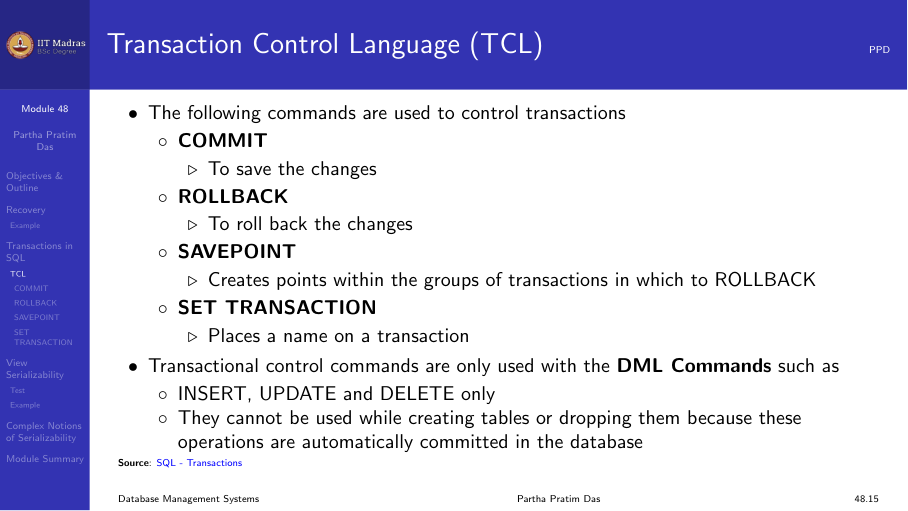
Transaction Control Language (TCL) commands manage transactions:
| Command | Purpose |
|---|---|
| COMMIT | Save changes permanently |
| ROLLBACK | Undo changes since last COMMIT |
| SAVEPOINT | Set a point within a transaction |
| RELEASE SAVEPOINT | Remove a savepoint |
COMMIT
COMMIT saves all transactions to the database since the last COMMIT or ROLLBACK.
COMMIT;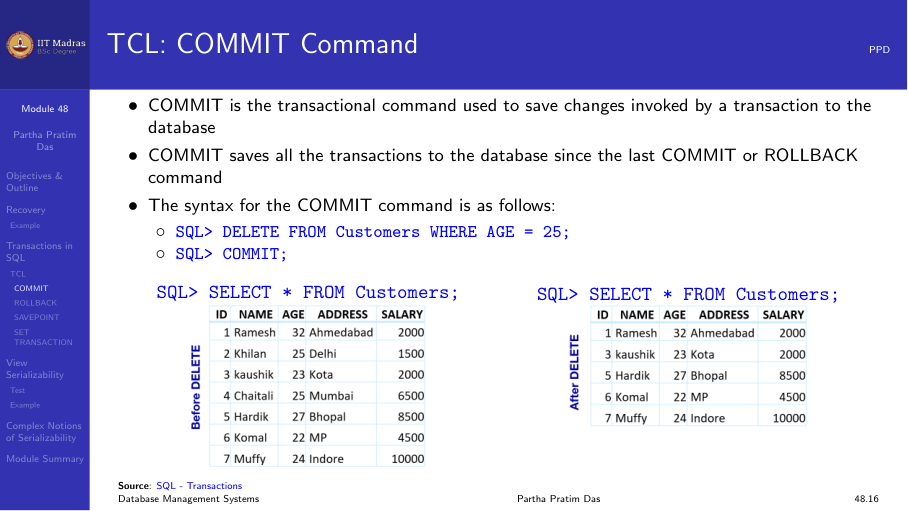
ROLLBACK
ROLLBACK undoes transactions since the last COMMIT or ROLLBACK.
ROLLBACK;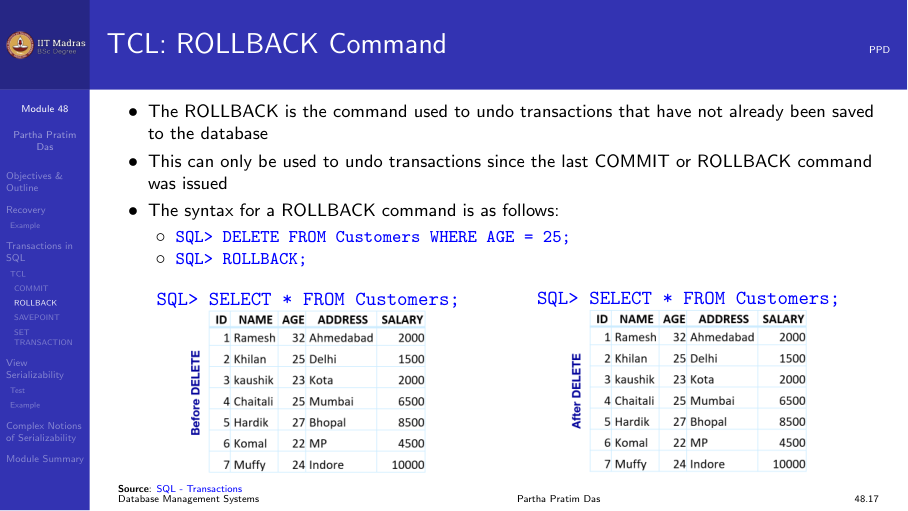
SAVEPOINT
A SAVEPOINT is a point within a transaction to which you can roll back without affecting the entire transaction.
SAVEPOINT sp1;
DELETE FROM student WHERE age > 25;
ROLLBACK TO sp1;  -- undo the delete, but keep earlier changes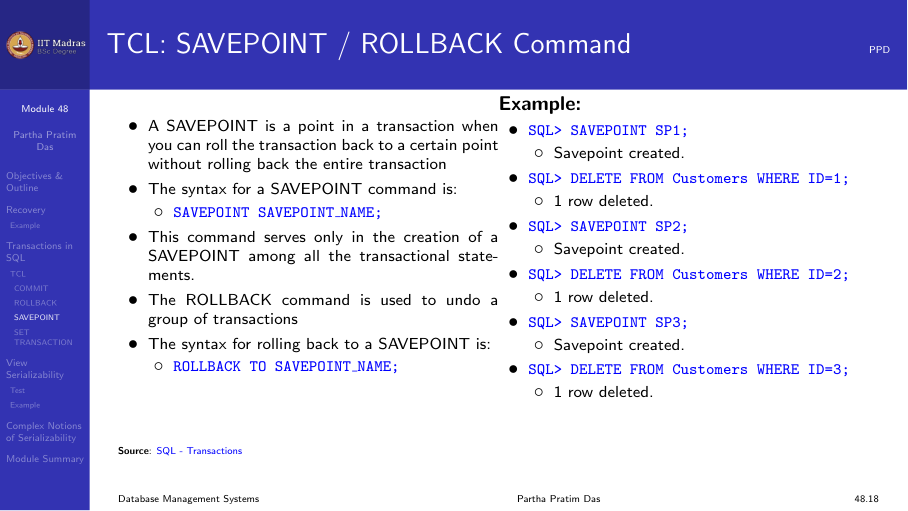
RELEASE SAVEPOINT
Removes a savepoint. After releasing, you can no longer roll back to that point.
RELEASE SAVEPOINT sp1;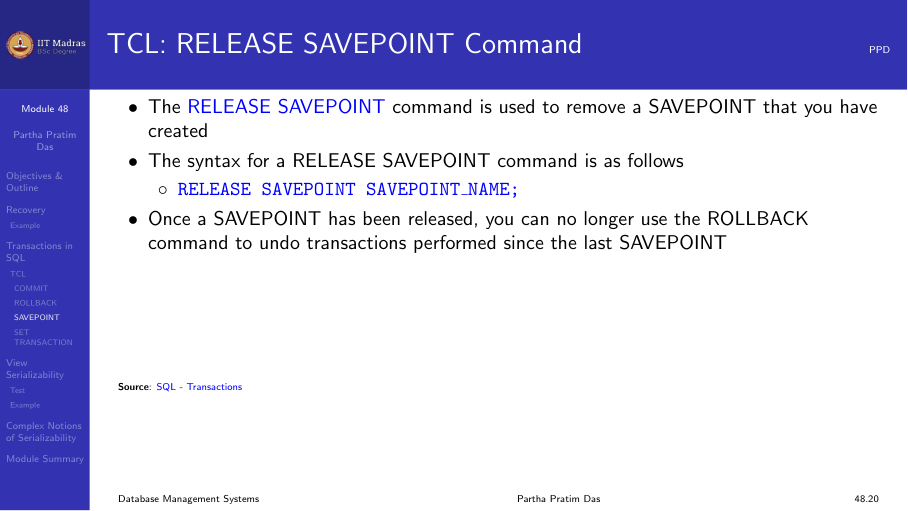
Example
SAVEPOINT sp1;
DELETE FROM student WHERE id = 1;
DELETE FROM student WHERE id = 2;
DELETE FROM student WHERE id = 3;
ROLLBACK TO sp1;  -- undo the three deletes
Only the SAVEPOINT sp1 remains; the three deletes are rolled back.
Summary
- Recoverable schedules ensure that a transaction commits only after all transactions whose data it read have committed.
- Cascading rollbacks occur when one transaction’s abort forces others to abort. Cascadeless schedules prevent this.
- COMMIT makes changes permanent; ROLLBACK undoes changes.
- SAVEPOINT allows partial rollback within a transaction.